Ask most people whether a night at the bingo costs more than it did twenty years ago and they’ll say yes, of course it does. Everything else has. A pint, a bus fare, a bag of chips on the way home, all of it has climbed. It seems obvious that bingo would have climbed with it.
It hasn’t. We pulled together what a bingo night cost in 2005 and what it costs in 2026, and the game itself turns out to be one of the few things in that night out that has actually got cheaper. Not just cheaper than inflation. Cheaper full stop. And online, far cheaper than that.
This piece is about where the money goes on a bingo night, and how that’s shifted. The short version is that the night out got dearer while the bingo got cheaper, and the two have been quietly pulling apart for two decades.
Why 2005 is the year to measure from
2005 isn’t an arbitrary pick. It’s the last year bingo looked the way it had looked for decades.
Bingo clubs were members’ clubs back then. You couldn’t walk in off the street and play. You joined, and there was a 24-hour wait before your first game. Advertising was restricted too. It was a quiet, slightly closed-off world, and it had been that way since the 1960s.
Over the next two years, that world ended. The Gambling Act 2005 removed the members’-club requirement and lifted the advertising restrictions.[1] The smoking ban arrived close behind it, in Scotland in 2006 and in England and Wales in 2007, and a clear majority of bingo-hall regulars were smokers.[2] Clubs started closing in numbers, and the count has fallen ever since.
So 2005 is a genuine “before”. It’s the last clean snapshot of bingo as it was, which makes it the right place to start the clock.
What a bingo night cost in 2005
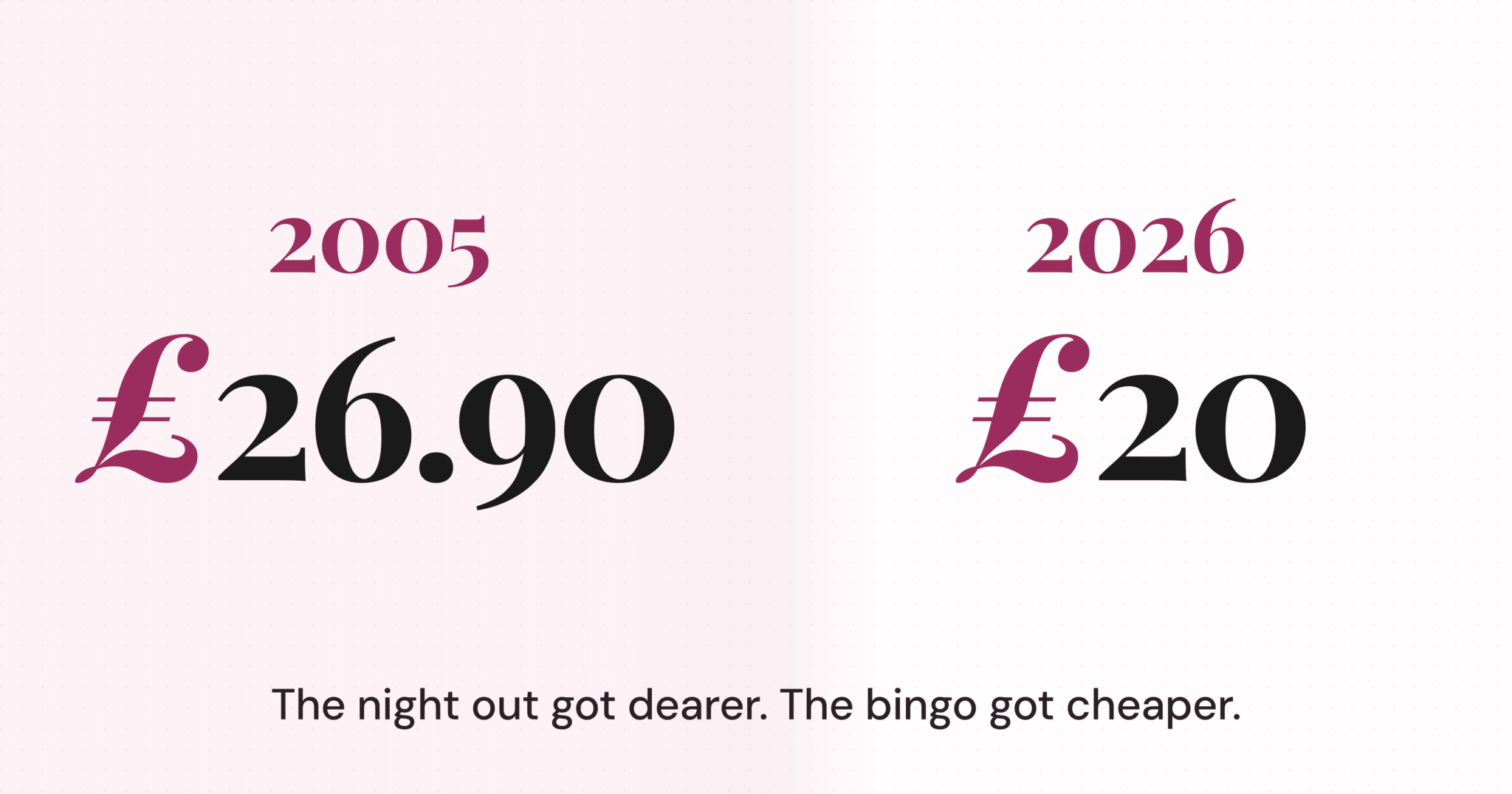
The market research firm Mintel put the average spend per visit to a UK bingo club at £26.90 in 2005.[3] That figure covered everything a player spent inside the club: the books, the National Bingo Game tickets, the interval games, money fed into the gaming machines, and a drink or a bite from the café.
A session was built around a main book of around eleven pages, bought at the desk on the way in, with extras added on top. Flyers, National Bingo Game tickets, early and late sessions, the lot. You paid as you went.
The drink was cheap. A pint of lager averaged £2.41 across the UK in 2005, according to the ONS.[4] Bingo-club bars usually ran a little under pub prices, and most players had one or two, not a session’s worth.
Admission itself was little or nothing. A Mecca television advert from 2004 went as far as offering free bingo on a Thursday night,[5] which tells you where the money actually came from. Clubs made theirs on the books and the machines, not on the door.
What it costs in 2026
A new member at Mecca Bingo in 2026 can pick up a starter package for £5. That buys a main game book, the National Game, a seasonal flyer, a couple of side games and a house drink.[6] It’s a loss-leader, clearly, but it tells you something on its own. The cost of getting a person playing bingo has been pushed about as low as it will go.
A full evening session on paper books, nineteen games, comes in at just under £20. Daytime and short sessions start at £2. There’s a dearer electronic-terminal package at £46.50, which gives you thirty tickets a game instead of a single book, but that’s a different way of playing rather than the standard night out.
The pint, meanwhile, has roughly doubled. The same ONS series has draught lager at around £5.00 in 2026, against that £2.41 in 2005.
The thing that doubled, and the thing that didn’t
Put the 2005 figures into today’s money and the gap jumps out. That £26.90 visit, adjusted for inflation, is about £52.[7] A 2026 evening on paper books is just under £20. Even setting the all-in 2005 figure, which included the gaming machines, against the bingo-only 2026 figure, the cost has come down. In real terms it’s come down a long way.
| What | 2005 price | If it had only tracked inflation | Actual 2026 price |
|---|---|---|---|
| A typical bingo-club visit | £26.90 | ~£52 | Just under £20 |
| A pint of lager | £2.41 | ~£4.67 | ~£5.00 |
| A pack of 20 cigarettes | ~£4.64 | ~£9.00 | ~£16.00 |
Two of those three lines moved against the bingo. A pint of lager at £2.41 in 2005 would be about £4.67 today if it had simply tracked inflation. It’s nearer £5.00. Cigarettes have done far more than keep pace. A pack of 20 cost a little under £5 in 2005 and runs to around £16 now,[8] more than triple. Twenty years of tobacco duty rises did that. And in 2005, you still smoked at your table in the hall.
That’s the split, and it’s the heart of this piece. The things around the bingo, the drink and the cigarettes, held their value or beat inflation. The bingo itself went the other way, and it went in the player’s favour.
Playing for pennies
The bigger shift is online. In 2005, online bingo barely existed as a mainstream thing. If you wanted to play, you went to a club, and that set a hard floor under the cost. The books, plus whatever it took to get yourself there.
In 2026 that floor is gone. Online bingo tickets start at 1p and typically run between 5p and 15p. You can play a real, prize-paying game of bingo for less than the cost of a single sweet.
And the night around it shrinks to almost nothing. No bus fare. No taxi home. The snacks come from your own cupboard at supermarket prices rather than club prices, and there’s no getting dressed up to sit on your own sofa. Played this way, the “cost of a bingo night” can genuinely be pennies.
What the cheap option costs you
This is where the honest accounting comes in, because cheaper isn’t the whole story.
What the online game doesn’t have is the room. The caller’s voice. Eyes down across a hall full of people. That particular feeling of being one number away, and the half-second after you shout house. None of those things carry a price, which is exactly why they don’t show up when you add up what a night costs.
We’re not going to tell you one version is better than the other. Plenty of players do both, the club for the social side and online for a quiet game on a weeknight. But we’d rather be straight about the trade. The money you save by playing online is real. So is the thing you’re no longer paying for.
What it all means
Bingo is one of the very few nights out in Britain that has become more affordable since 2005, not less. While the pint doubled, and wages roughly doubled along with it, the cost of actually playing bingo drifted down. Online, it fell off a cliff.
That runs against almost everything else in the leisure budget. Most ways of spending an evening out have gone the other way, and bingo quietly went against the grain.
Bingo is plainly cheap now, cheaper than it has been in a long time. The open question is a different one. The cheapest version of bingo is the online version, and it’s the version that strips out everything except the game itself. Whether that’s still the thing players fell for, or just its quietest and most convenient substitute, is something the price of a ticket can’t tell you.