Mecca Bingo Exeter called its last house on Sunday 7 June 2026, after 63 years of bingo at the same address, with 22 staff out of work. Exeter has 138,000 residents. The city’s MP pointed out that the nearest alternative would now be Torquay. On our measurements that’s 17.7 miles.
We keep a page for every bingo hall in the UK, open or closed, verified club by club. This report takes that directory and asks a different question from our census, which counted what’s left. This one measures how far people now have to go to reach it. All figures are our count as at 28 July 2026.
What the map shows
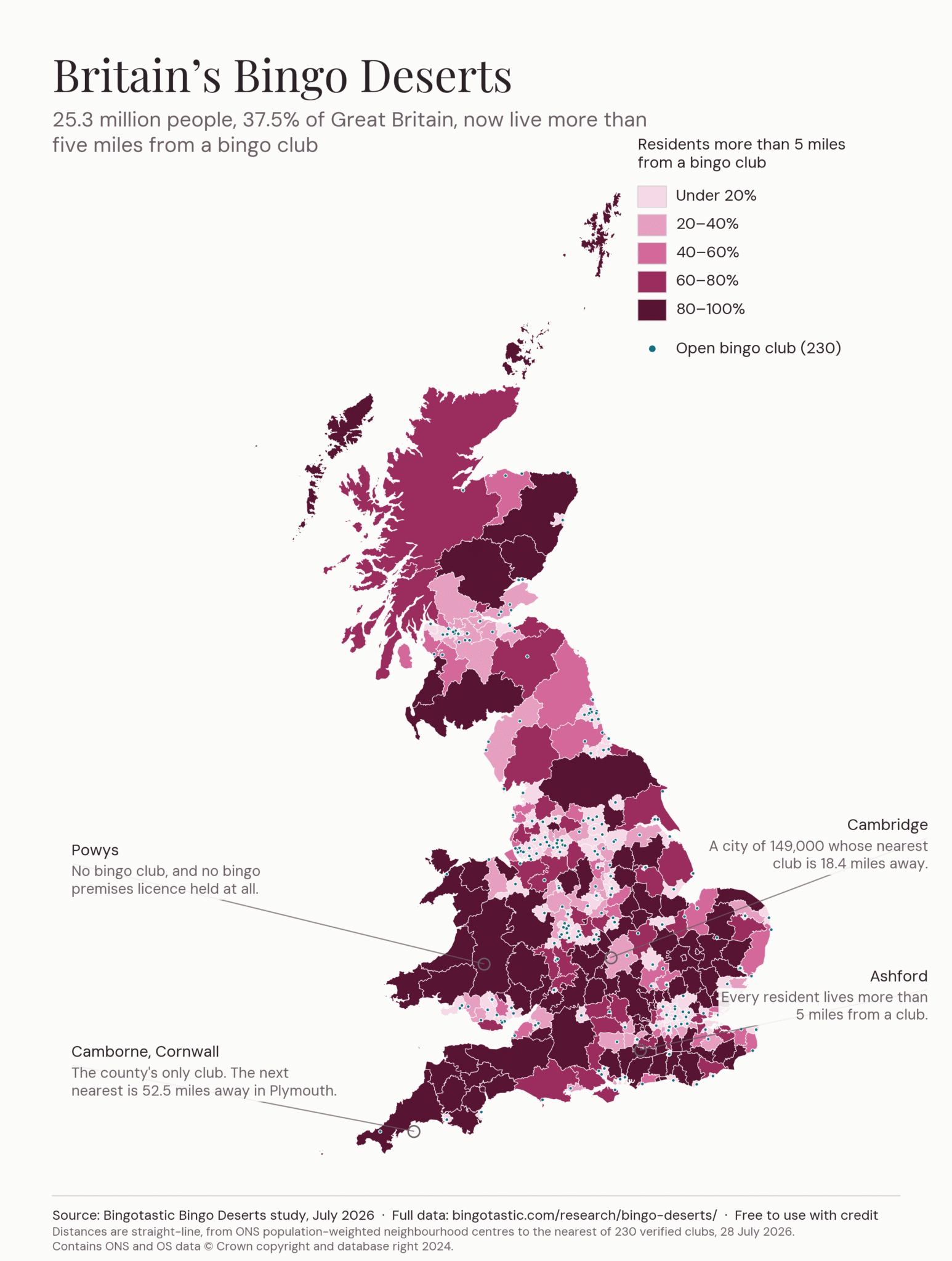
There are 230 bingo clubs still open across Great Britain on our count. We took all of them, worked out where they sit, and measured the distance from every neighbourhood in the country to its nearest one.
Just over 25 million people, 37.5% of the population, live more than five miles from a bingo club. Nearly 12 million live more than ten miles away. And 5.75 million, roughly one person in twelve, live more than 15 miles from the nearest club.
The typical person is fine. The median distance to a club is 3.5 miles, which is a bus ride or a short drive. The country splits sharply either side of that, and the people on the wrong side of it are a long way out.
Five miles is further than it sounds
Five miles is nothing in a car. That’s rather the point.
Bingo’s audience in Britain is markedly more female than the population as a whole. The Gambling Commission’s own survey found women almost twice as likely as men to have played bingo in the past month, 6% against 3%.[1]
And a lot of the people who fill a weekday afternoon session don’t drive. Department for Transport figures for 2024 show 64% of women aged 70 and over in England hold a full driving licence, so more than a third of them don’t.[2] For them, five miles means the bus.
And the bus has been going the same way as the clubs. Local bus mileage in England outside London has fallen 28% since 2005, from 1,026.7 million vehicle miles to 736.4 million in the year to March 2025.[3]
Two things shrinking at once compound. A club that closes six miles from you was already awkward to reach. The bus route that made it possible is often the next thing to go.
The divide isn’t north and south
Ask most people where Britain’s bingo has disappeared and they’ll say the north, or the old industrial towns. The data says something different.
London is the best-served place in the country. The median Londoner lives 2.6 miles from a bingo club and fewer than one in ten is more than five miles away. The big metropolitan areas are almost identical, at 2.2 miles. Sheffield, Leeds, Birmingham and Manchester residents are, on the whole, closer to a club than people almost anywhere else.
Go out into the county areas and it’s the other way round. There, 59% of people live more than five miles from a club, and the median distance more than doubles to 6.1 miles. England’s unitary authority areas sit in between at 45.2%.
Wales is the hardest-hit nation, with 47.5% of people beyond five miles. Rural Wales pulls that figure a long way up. Neither Ceredigion nor Pembrokeshire has a single traditional bingo club, and Powys doesn’t hold a bingo premises licence of any kind.[4] Haverfordwest is 44.8 miles from its nearest club in Swansea. Aberystwyth’s nearest is Caernarfon, 50.9 miles up the coast.
The bingo desert is a countryside and small-town story, and it always has been. Closures in cities make the local paper because the buildings are big and the staff numbers are visible. The slow disappearance of clubs from market towns doesn’t, because there was only ever one to lose.
Scotland plays closest
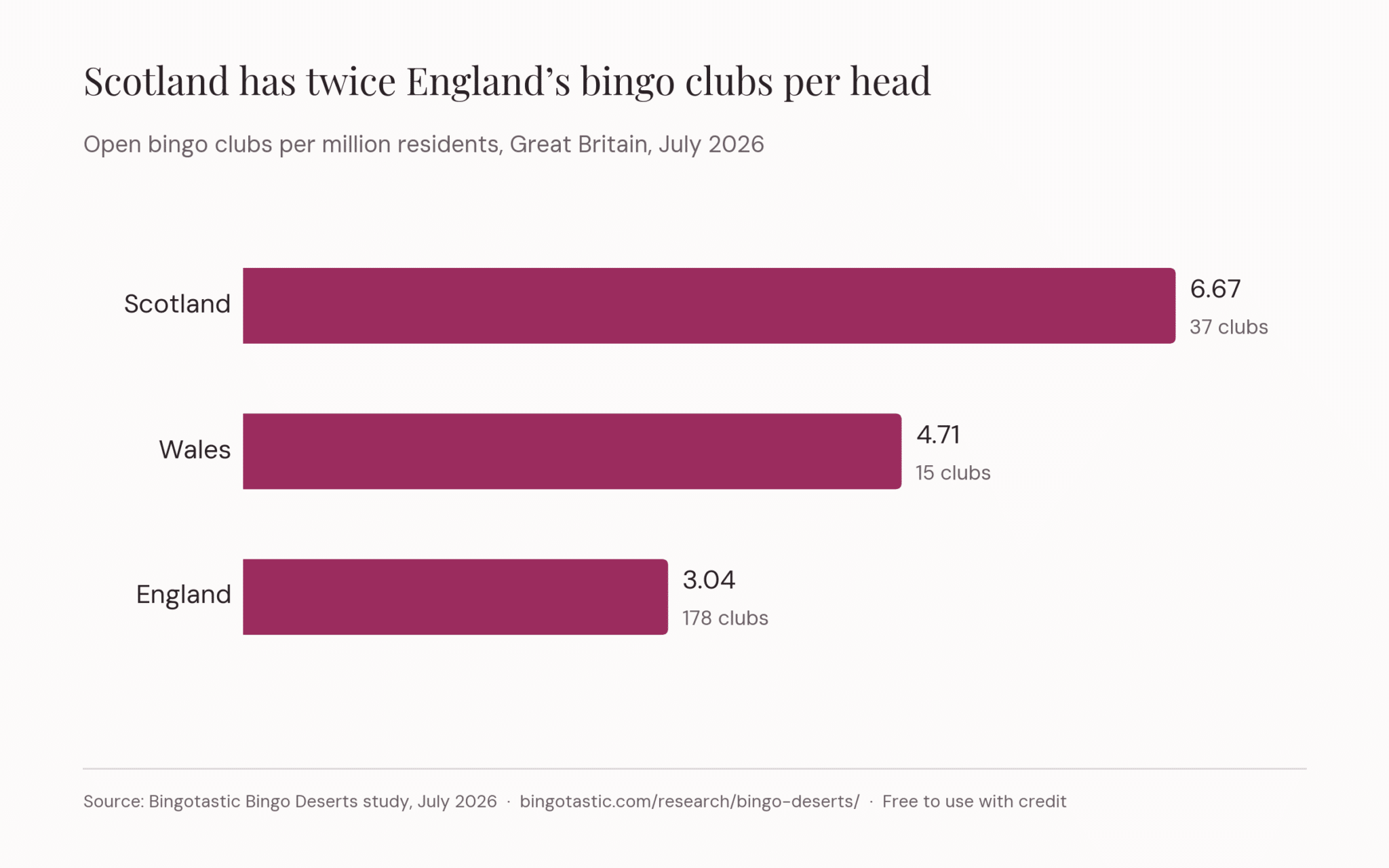
Scotland has 37 clubs for 5.5 million people, which works out at 6.67 clubs per million. England has 178 for 58.6 million, or 3.04 per million. That’s more than twice as many clubs per head, and the median Scot lives 3.1 miles from one, marginally closer than the median resident of England.
Wales has 15 clubs, or 4.71 per million, though its geography means those clubs are spread thinly across long distances.
Scotland’s independent sector is a big part of the explanation. Carlton Clubs, Club 3000 and a long tail of single-site operators have held on in towns where the big chains never arrived or long since left.
The clubs with no neighbour
A closure matters most where there’s nothing else nearby. So we measured the distance from every open club to the next nearest one.
For most clubs, the answer is reassuring. Of the 230 still trading, 124 have another club within five miles. Lose one of those and the regulars have somewhere to go, even if it means a different night and a longer walk.
Sixteen clubs are more than 20 miles from the next nearest. Four are more than 30. These are the ones where a closure doesn’t just shut a building, it takes bingo out of a whole area.
Apollo Bingo in Camborne is the most isolated club in Britain. The next nearest is 52.5 miles away in Plymouth. It is also the last bingo club in Cornwall, after the Capitol in St Austell surrendered its bingo licence in March 2025.[5] If Camborne ever goes, the whole of west Cornwall goes with it.
| Club | Town | Miles to next nearest club | Next nearest is in |
|---|---|---|---|
| Apollo Bingo | Camborne, Cornwall | 52.5 | Plymouth |
| Carlton Bingo | Fraserburgh | 35.6 | Buckie |
| Apollo Bingo | Caernarfon | 34.8 | Rhyl |
| Carlton Bingo | Inverness | 34.6 | Elgin |
| Opera Bingo | Carlisle | 29.3 | Workington |
| Winners Bingo | Thetford | 27.6 | Norwich |
| Buzz Bingo | Torquay | 27.4 | Plymouth |
| Buzz Bingo Charles Cross | Plymouth | 27.4 | Torquay |
| Buzz Bingo | Lincoln | 25.6 | Scunthorpe |
| Leo Leisure | Weymouth | 23.7 | Poole |
| Buzz Bingo Tower Park | Poole | 23.7 | Weymouth |
| Buzz Bingo | Gloucester | 23.2 | Worcester |
One warning about reading lists like this. Counting clubs by town name makes big cities look far emptier than they are. The City of Manchester holds two clubs, which sounds thin for a city that size until you look at Greater Manchester and find thirteen across the ten boroughs, none of them more than 5.3 miles from another. Distance is the honest measure. Town labels aren’t.
The places that have already lost it
Some parts of the country have lost bingo altogether, and those gaps show up clearly once you measure them properly rather than by council boundary.
Cambridge has no bingo club. The nearest is Flutters in Biggleswade, 18.4 miles away. Ashford in Kent lost its Mecca and the nearest is now Maidstone, 16.7 miles off. Barnstaple’s nearest club is 36.2 miles away in Bridgend, on the other side of the Bristol Channel, which is a short hop on the map and most of a morning in the car.
Exeter joined that list this June, one of eight Mecca clubs to close on the same Sunday on our count.[6] Bingo had been played at 12 North Street since 1963, when the old Gaumont cinema was converted, and the city’s MP wrote to Rank’s chief executive to try to stop it going.[7]
One caution on all of this. High-street slots venues aren’t bingo clubs, whatever their licence says, and we haven’t counted them. Merkur Slots alone holds 227 of the 777 bingo premises licences in Great Britain without operating a traditional hall at any of them.[8] If your high street has a bright shopfront with “bingo” above the door and no seats, no caller and no session times, that’s why the town still shows as empty here.
The tax cut that arrived after the closures
Bingo Duty, the 10% levy on club profits, was abolished on 1 April 2026. The Bingo Association called it transformative and the Treasury described bingo clubs as being about community, friendship and fun. Around 250 clubs and 7,000 jobs stood to benefit.[9]
It’s a real change and the industry had campaigned for it for years. No tax break brings back a building that has already been sold, though, and most of the closures in our data happened well before April. We looked at that in more detail in our study of what happened to the halls that closed.
The clubs that survived to see the duty scrapped are, in a lot of places, the only one for miles. Whether the tax break slows the rate of closure is the question we’ll be able to answer next April, when our directory has a full year of trading under the new regime to measure.