On Sunday 7 June 2026, eight Mecca bingo halls called their last house. Birkenhead, Croydon, Exeter, Kingstanding, Sheffield, St Helens, Sunderland and Taunton all closed on the same day. Five of them made the local papers. Three of them closed without a single news story anywhere.
We know, because we count. Bingotastic keeps a page for every bingo hall in the UK, open or closed, and we verify each one against the operators’ own club finders. This report is the first full publication of that count, a census of the great British bingo hall taken in the year the game’s oldest tax died and its buildings kept closing anyway.
How many bingo halls are left?
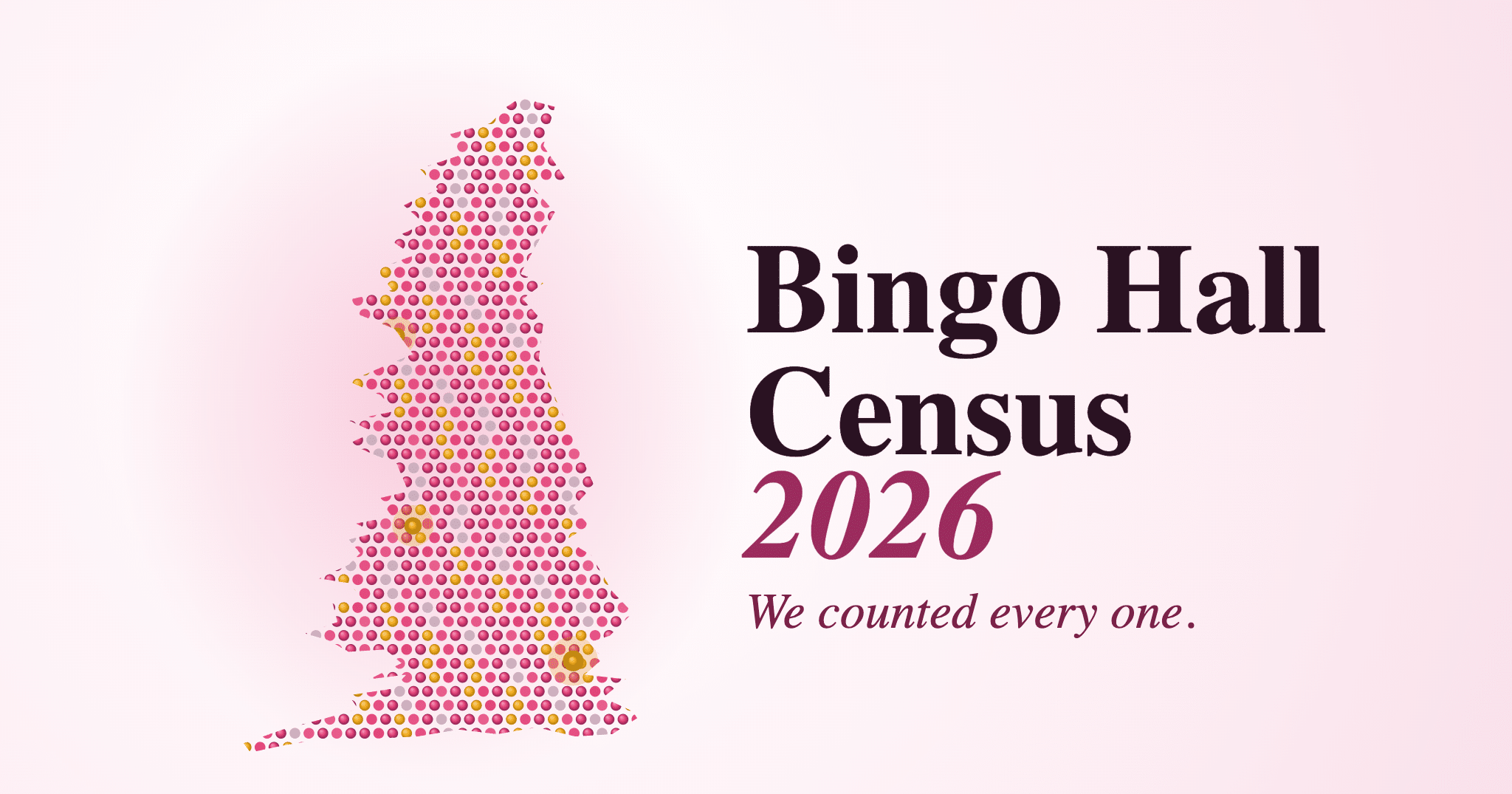
Our count, as of 9 July 2026, is 232 traditional bingo halls open across the UK. That covers every chain club and every independent we could verify, from Buzz Bingo’s 76 venues down to single-hall operators in seaside towns. Take out Northern Ireland’s four clubs and the Great Britain figure is 228, which sits close to the trade body’s own count of around 250 registered clubs.[1]
The longer view is stark. His Majesty’s Revenue and Customs put the number of British bingo clubs at roughly 1,360 in the 1980s.[2] The Bingo Association counted 585 in 2005 and 383 by 2014. Its registered clubs fell from 335 in December 2018 to 248 in August 2024.[3] Five out of every six halls that existed in the 1980s are gone.
| Year | Bingo halls | Counted by |
|---|---|---|
| 1980s | ~1,360 | HMRC |
| 2005 | 585 | Bingo Association |
| 2014 | 383 | Bingo Association |
| 2018 | 335 | Bingo Association (registered clubs) |
| 2024 | 248 | Bingo Association (registered clubs, August) |
| 2026 | 232 | Bingotastic census (UK, July) |
Who runs what is worth a moment too. Buzz Bingo operates 76 halls and Mecca 41, so the two giants hold barely half the estate between them. The rest belongs to Club 3000 (24), Castle Bingo (11), Carlton Bingo in Scotland (10), a handful of smaller groups, and 65 independent halls. The independents are the quiet story here. Nobody counts them nationally, several are the last hall for miles, and as we’ll see below, they’re where most of the good news now comes from.
Be sceptical of official statistics
Here’s a strange fact. The Gambling Commission’s count of “bingo premises” in Great Britain went up last year, from 631 to 684.[4] Read that number in a government report and you’d conclude the sector is in rude health, with bingo premises up 8% in a single year.
The catch is what counts as a bingo premises. A licence to offer bingo has become the licence of choice for high-street slot machine venues, because it permits unlimited lower-stake machines and, unlike an arcade licence, doesn’t prohibit alcohol. The single largest holder of bingo premises licences in Britain today is Merkur Slots UK Limited, with 227 of them. Merkur operates no traditional bingo halls at all. It sold its last two, Cricklewood and Northampton, to Buzz Bingo in 2024.[5]
The government knows. Its own consultation paper says these venues “give the appearance to consumers of being adult gaming centres” and reports that among high-street bingo operators, less than 1% of revenue comes from bingo. Across the whole licensed bingo sector, gaming machines now take 63p of every pound.[6] Ministers are consulting on rules that would force anything called a bingo premises to contain an actual bingo area with actual seats.
On paper, Britain gained 53 bingo premises last year. On the ground, it lost a dozen bingo halls. Both numbers are true. Only one of them has anything to do with bingo.
For this census we count the halls. A venue makes our list if you can walk in and play a proper session of cash bingo in a room built for it. Slots venues holding bingo licences don’t qualify, however the paperwork reads.
Twelve months of closures, named
Between July 2025 and July 2026 we recorded 12 permanent hall closures. Mecca accounts for nine of them, Buzz Bingo for three. Every one is listed below, with the reason where one was ever given.
| Hall | Closed | Stated reason |
|---|---|---|
| Mecca Scarborough | 23 Nov 2025 | Lease ended; Grade II listed Capitol Theatre building |
| Buzz Bingo Wallsend | 18 Jan 2026 | None given; site subject of a retail conversion application |
| Buzz Bingo Shrewsbury | 31 Jan 2026 | Grade II listed former Granada Theatre sold to a developer |
| Buzz Bingo Birmingham Great Park | Early 2026* | None given; no press coverage of the closure exists |
| Mecca Birkenhead | 7 Jun 2026 | Lease ending; “no longer commercially viable” |
| Mecca Croydon | 7 Jun 2026 | None given; no press coverage |
| Mecca Exeter | 7 Jun 2026 | Lease ending and heavy repair costs |
| Mecca Kingstanding | 7 Jun 2026 | Poor profitability and repair costs; no press coverage |
| Mecca Sheffield | 7 Jun 2026 | Major repair challenges; ex-Odeon, bingo for 55 years |
| Mecca St Helens | 7 Jun 2026 | Lease ending; “no longer commercially viable” |
| Mecca Sunderland | 7 Jun 2026 | None given; no press coverage |
| Mecca Taunton | 7 Jun 2026 | Lease ended; Grade II listed Gaumont, repair costs |
* Buzz Bingo Birmingham Great Park was trading in early December 2025 and confirmed permanently closed by March 2026. No announcement or news report was ever published; the window comes from archived copies of Buzz’s own website.
The 7 June round deserves a closer look. Eight halls in one day is, as far as our records go, the largest single-day closure of bingo halls in modern British history. It was never announced as a group. Even the industry’s own specialist press reported four closures in late June, and only corrected the figure to eight a month later. We verified all eight independently against Mecca’s own venue data. Kingstanding, Sunderland and Croydon closed with no coverage whatsoever. In Kingstanding’s case a hall that had served north Birmingham for decades simply stopped appearing on Mecca’s website.
“Nobody official counts bingo halls. The Gambling Commission counts licences, the operators announce what suits them, and when eight clubs shut on the same day this June, three of them didn’t make a single paper. We keep a page for every hall in the country, open or closed, so when one goes, at least somebody writes it down.” — Andrew Palmer, founder, Bingotastic
The tax died. The closures didn’t.
This was supposed to be the year the pressure came off. In the November 2025 Budget the Chancellor abolished Bingo Duty outright, a 10% tax on club profits that dated back decades. It ended on 1 April 2026. The Treasury minister called it “a full house win” for around 250 clubs and 7,000 jobs, and the Bingo Association called it transformative.[7] The same Budget raised the tax on online casino games from 21% to 40%. For once, the building beat the app.
Nine weeks after the duty died, Mecca closed eight halls in a day.
That’s not evidence the tax cut failed. Rank, Mecca’s owner, told investors in April that the abolition would help push Mecca to double-digit profit growth next year. But look down the closure table again and count how many reasons mention demand. None do. The words that repeat are lease, landlord, repairs and listed building. Halls are closing because their buildings are worth more as flats, retail or storage, and because a 90-year-old former cinema costs a fortune to keep standing. A profits tax was never what was killing them, so removing it was never going to be what saves them.
The abolition is also smaller than the celebrations suggest, and the reason is sitting in the corner of every hall. Bingo Duty only ever applied to profits from the bingo games themselves. The gaming machines were always taxed separately, under Machine Games Duty at 20%, and the Budget left that entirely alone.[8] Machines now bring in £394m a year across Britain’s bingo premises against £234m from the bingo itself.[9] So the Treasury has scrapped a roughly £23m-a-year tax on the smaller slice of the takings, while the bigger slice carries on paying around £79m at double the old bingo rate. That’s real money back in the clubs’ pockets. It just isn’t most of the money.
Three of this year’s twelve closures took place in Grade II listed former picture palaces. Scarborough’s Capitol, Shrewsbury’s Granada and Taunton’s Gaumont all survived the death of cinema because bingo moved in and paid the bills for half a century. Sheffield’s ex-Odeon, bingo’s home for 55 years, joins them on the way out. What happens to those buildings now is a question for another report we’re working on.
Who’s fighting back
The year’s good news comes almost entirely from outside the big two chains.
Club 3000, a family-owned firm from Manchester, opened its 24th club in Leeds last August on a site Mecca had vacated, creating around 50 jobs. It’s now building a £5 million club in Sunderland, due to open in 2027, with the licence already granted. The location is the detail we can’t resist. It’s in The Bridges shopping centre, the very centre Mecca Sunderland left in June. One bingo brand moves out of a town; another spends £5 million to move in.[10]
The independents had a year of rescues. In Wisbech, the operator of the bingo hall in the Grade II* listed Empire Theatre quit with one day’s notice in July 2025. Regulars petitioned, a local leisure firm stepped in, and bingo returned to the Empire in November.
In Hastings, the 1921 Gaiety cinema reopened fully as The Deluxe bingo club in June 2025 after a two-year restoration.
In Hull, when Buzz’s building was sold from under it, the company bought the town’s independent club rather than leave, keeping every job.
And in Taunton, the fight is live. Since Mecca left the Gaumont in June, a community trust has gathered over 2,800 signatures to bring bingo back to the building. Whether it succeeds will say a lot about what these halls still mean to the towns around them.
Region by region
Bingo’s map is tilted north and west. The North West has more halls than anywhere else, Scotland is close behind, and on a per-person basis Wales is the most bingo-served nation in the UK. The West Midlands had the roughest year, losing three halls, while the South West holds the thinnest coverage in Britain with ten, two fewer than it had last summer.
| Region | Halls open | Closed in last 12 months |
|---|---|---|
| North West | 37 | 2 |
| Scotland | 36 | 0 |
| East of England | 21 | 0 |
| West Midlands | 21 | 3 |
| South East | 20 | 0 |
| Yorkshire & the Humber | 19 | 2 |
| East Midlands | 18 | 0 |
| Wales | 17 | 0 |
| North East | 15 | 2 |
| London | 14 | 1 |
| South West | 10 | 2 |
| Northern Ireland | 4 | 0 |
One closure is missing from the table on purpose. Club 3000 Bristol shut in October 2025 when its shopping centre came down for redevelopment, but a multi-million-pound replacement is planned across town for 2027, so we’ve logged it as temporary rather than permanent.
Scotland’s zero deserves a second look. Thirty-six halls, no closures, a brand-new multi-million-pound club opened in Leith in January 2025, and the National Bingo Game’s biggest-ever winner still lives in Coatbridge. Whatever is ailing the English bingo hall, it seems milder north of the border.
What happens next
Watch Scunthorpe. Buzz Bingo’s hall there is trading, but its landlord has served notice to convert the site to self-storage, and a planning appeal has reportedly gone the landlord’s way. Buzz says it’s looking for a new home in town. Whether Scunthorpe follows Hull (a rescue) or Wallsend (a quiet goodbye) will be one of next year’s data points.
The bigger question is the one the Treasury has already placed a bet on. April 2027 will mark one full year of duty-free bingo, and this census will be re-run then to answer it. If the tax cut works, we should see fewer closures, more investment of the Club 3000/Buzz Bingo kind, and perhaps the first year since the pandemic when Britain’s bingo hall count goes up instead of down. The buildings, the leases and the landlords will have a vote too.
“Scrapping bingo duty is welcome, but it’s smaller than it sounds. The duty only ever touched the bingo side of the business, a significant amount of the takings come from slot machines, which still pay machine games duty at twice the rate bingo was paying. It helps the clubs that survive. It doesn’t renew a lease, or fix a listed building roof, which caused the latest bingo hall closures.” — Andrew Palmer, founder, Bingotastic