Somewhere in Dundee tonight, a crowd will queue for a gig on a floor where clickety-click echoed for fifty years. In Andover, the old Mecca is a mosque. In Peterhead, a building that spent decades calling numbers has gone back to its first love and is showing films again. And in thirty-seven towns across Britain, the bingo hall is simply dark.
This week our Bingo Hall Census counted what bingo still has: 232 halls. This report traces what it lost. We took every closed bingo hall in our directory, 202 unique buildings once the rebrands were untangled, and found out what each one is today.
How we traced them
Our starting point was the same directory that powers our census: an individual, dated page for each UK hall, open or closed, going back to when Bingotastic started keeping records in 2013. It holds 252 closed-hall entries; 50 of those turned out to be the same building recorded under two brands, which left 202 unique buildings to investigate. Thirteen years of closures, traced one building at a time.
Each one was anchored to its street address, then checked against business listings, local newspaper archives, council planning applications, commercial property listings and the CinemaTreasures archive, which documents the picture houses so many halls began life as. Every classification carries a confidence grade and the sources behind it, and every claim was independently re-checked before publication. Where we couldn’t establish a building’s fate, we recorded it as unknown rather than guessing. Thirteen ended up in that column.
Half the lost halls were never lost
The first finding rewrites the question. Of 202 buildings that appear in our records as closed bingo halls, 92 are still playing bingo right now. Their “closure” was a name change.
Most of these date to 2018, when the Gala retail estate rebranded to Buzz Bingo and roughly a hundred venues swapped signs overnight. A smaller wave came from Club 3000 taking over sites the big chains left, in places like Ellesmere Port, Greenock and Cwmbran. The bingo never stopped. Anyone compiling a list of “Britain’s dead bingo halls” without checking the doors would overcount the casualties by almost double, and plenty of lists online do exactly that.
The real story is the other 110 buildings, the ones where the caller fell silent for good.
What Britain built on bingo
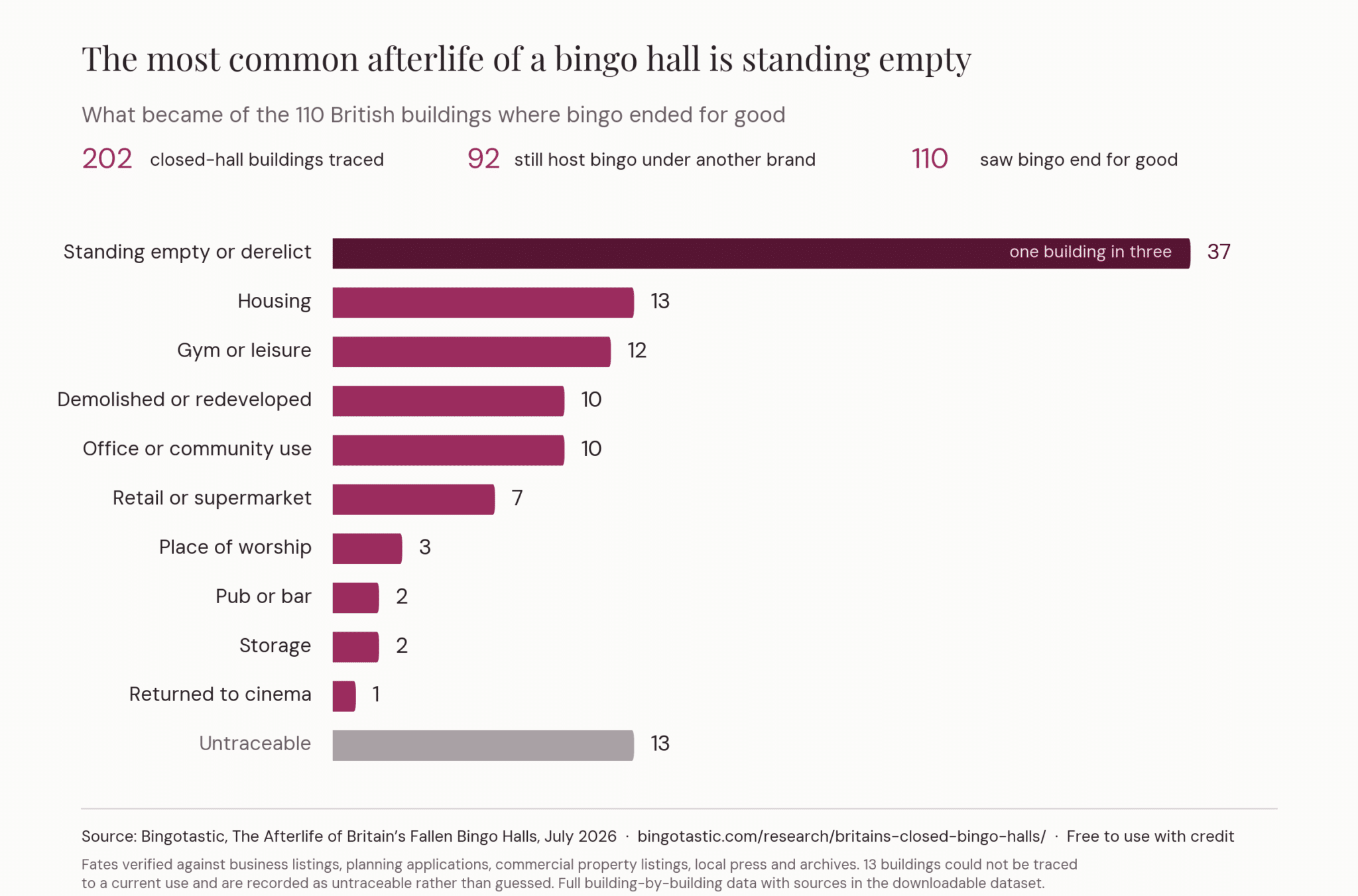
Here’s what those 110 buildings are today.
| What the building is now | Buildings | Share |
|---|---|---|
| Standing empty or derelict | 37 | 34% |
| Housing (built or approved) | 13 | 12% |
| Venues, gyms and leisure | 12 | 11% |
| Demolished and redeveloped | 10 | 9% |
| Offices and community space | 10 | 9% |
| Shops and supermarkets | 7 | 6% |
| Places of worship | 3 | 3% |
| Pubs and bars | 2 | 2% |
| Storage | 2 | 2% |
| A cinema again | 1 | 1% |
| Untraceable | 13 | 12% |
Read that top line again. The most common thing Britain builds on a dead bingo hall is nothing at all.
The empty ones
Thirty-seven buildings stand vacant, and vacancy is rarely kind to them. These are big structures with big roofs and big heating bills, many of them former cinemas pushing ninety years old, and they don’t wait patiently. The old Gala in Kettering shows where waiting can lead: derelict since closure, it made national news in 2019 when police found a cannabis farm of around 2,000 plants filling the building, with an estimated output of £2.8m a year.[1] A local campaign now wants it revived as a cinema and community venue.
The vacancy list has some famous company. Buzz Bingo’s old home in Milton Keynes sits inside The Point, Britain’s first purpose-built multiplex cinema, whose glowing red pyramid survived a demolition bid in 2024 and now stands largely tenantless, a 1985 landmark with almost nothing left inside it.
A fairness note on the number: it includes the eight Mecca halls that closed this June, which have barely had time to be anything yet. But most of the 37 have been empty for years, not weeks. Our census logs every closure as it happens, so next year we’ll know which of these found a future and which are still waiting.
People assume demolition is the sad ending. The empty ones are sadder. A demolished hall at least became something that people use. Thirty-seven of these are just sitting there, abandoned, and every winter that passes makes them harder to save.” — Andrew Palmer, founder, Bingotastic
The second lives
When a hall does find a new purpose, the results run from the sensible to the wonderful.
The wonderful first. In Dundee, the old Mecca in the Green’s Playhouse reopened in May 2025 as LiveHouse, a music venue that has already hosted the Kaiser Chiefs.[2] In Peterhead, the 1939 Regal, which spent its middle age as a Gala, has gone full circle and is a working cinema again. It is the only building in the dataset that went back to what it was born as.
The sensible: thirteen buildings are housing, built or approved, from new-build flats in Wandsworth to 280 student flats replacing the demolished Mecca in York and around 500 more planned on the Wood Green site. There is a generational turn in that number worth sitting with. The rooms built for a night out with your nan are being rebuilt to house her grandchildren. Seven became retail, including a Smyths toy superstore in Barrow and two B&Ms. Ten are offices or community space. Ten more were demolished for wider redevelopment, taking a shopping centre or a leisure park with them. And two became pubs, a number that looks small only because our records start in 2013. Trace the bingo-to-pub pipeline back through the whole twentieth century and it turns out to be one of the great British building stories, which is why it’s getting a report of its own shortly.
Eyes down, heads bowed
Three buildings deserve their own section, because their second life rhymes with their first. In Grays, the Grade II listed 1940 Ritz, all streamlined Moderne curves and Art Deco plasterwork, spent thirty-six years as a bingo club and is now the House of Praise, a Redeemed Christian Church of God congregation. In Dartford, the old Granada that hosted bingo from 1975 is now Net Church, its name up in letters where the cinema canopy used to be. And Andover’s Mecca is now a mosque, a conversion that went through the town’s planning process like any other change of use.
It makes a plain kind of sense. A bingo hall is a room built to gather several hundred people at fixed times each week, with the seats, the stage, the acoustics and the car park already in place. That is also, more or less, the specification for a place of worship. These buildings have spent their whole lives bringing a town together in one room. Only what’s called out from the front has changed.
Grays points at a bigger pattern running under this whole dataset. At least 56 of the 202 buildings, more than a quarter, have documented lives as cinemas or theatres before the bingo arrived, and at least nine are listed. For half a century, bingo was quietly the country’s largest preservation scheme for its picture palaces, paying the bills the films no longer could. What happens to that architecture now the bingo is leaving too is a report we’re already working on.
Region by region
The afterlife is not evenly distributed. London’s lost halls almost all found new lives: 14 of 22 have new uses and only 2 sit empty, because land that valuable doesn’t wait. The West Midlands tells the opposite story, with 8 of its 23 buildings standing vacant, the worst rate in Britain. The North East barely appears in this report at all, and Wales supplies just two buildings, which squares with our census finding that Welsh halls mostly stayed open.
| Region | Buildings | Still bingo | New use | Empty | Untraced |
|---|---|---|---|---|---|
| North West | 29 | 13 | 13 | 2 | 1 |
| Scotland | 24 | 13 | 4 | 3 | 4 |
| Yorkshire | 24 | 13 | 4 | 5 | 2 |
| South East | 23 | 8 | 10 | 5 | 0 |
| West Midlands | 23 | 9 | 3 | 8 | 3 |
| London | 22 | 6 | 14 | 2 | 0 |
| South West | 19 | 8 | 5 | 6 | 0 |
| East Midlands | 17 | 8 | 3 | 4 | 2 |
| East of England | 10 | 6 | 2 | 1 | 1 |
| North East | 9 | 7 | 2 | 0 | 0 |
| Wales | 2 | 1 | 0 | 1 | 0 |
What happens next
This dataset now updates itself. Every hall that closes joins it, our census logs the closure date, and a year from now we’ll re-trace the 37 empty buildings and report which ones moved. The eight halls Mecca shut in June are the first test cases: watch whether they follow London’s path or the West Midlands’.
Everyone writes about bingo halls closing. Nobody follows the buildings afterwards, and the buildings are where the story actually ends. Now there’s a record.” — Andrew Palmer, founder, Bingotastic