
The honest answer is that you can’t make a bingo ticket more likely to win. Every ticket in a game has the same chance, and no number-picking strategy changes that.
We put the famous strategies through 500,000 simulated games to prove it. What you can change is how often you win, what each win costs you, and whether you’re getting decent value for your money. That part is worth knowing.
Can You Actually Win More Often?
Yes, but not by being clever with your numbers. In Britain, bingo has to be an equal-chance game, so your ticket has the same shot as every other ticket in the room.
That leaves two things you control. One is how many tickets you hold compared with everyone else. The other is which game you play, and how many other people are playing it. Both change how often you win. Neither changes the price of winning, as the rest of this guide shows.
Popular Bingo Strategies, Tested
Search for bingo tips, and you’ll soon meet two “systems” with names attached. The Tippett method says to pick cards with numbers clustered near the middle of the range for long games. The Granville method says to pick a card with its numbers spread evenly, mixing odds and evens and high and low.
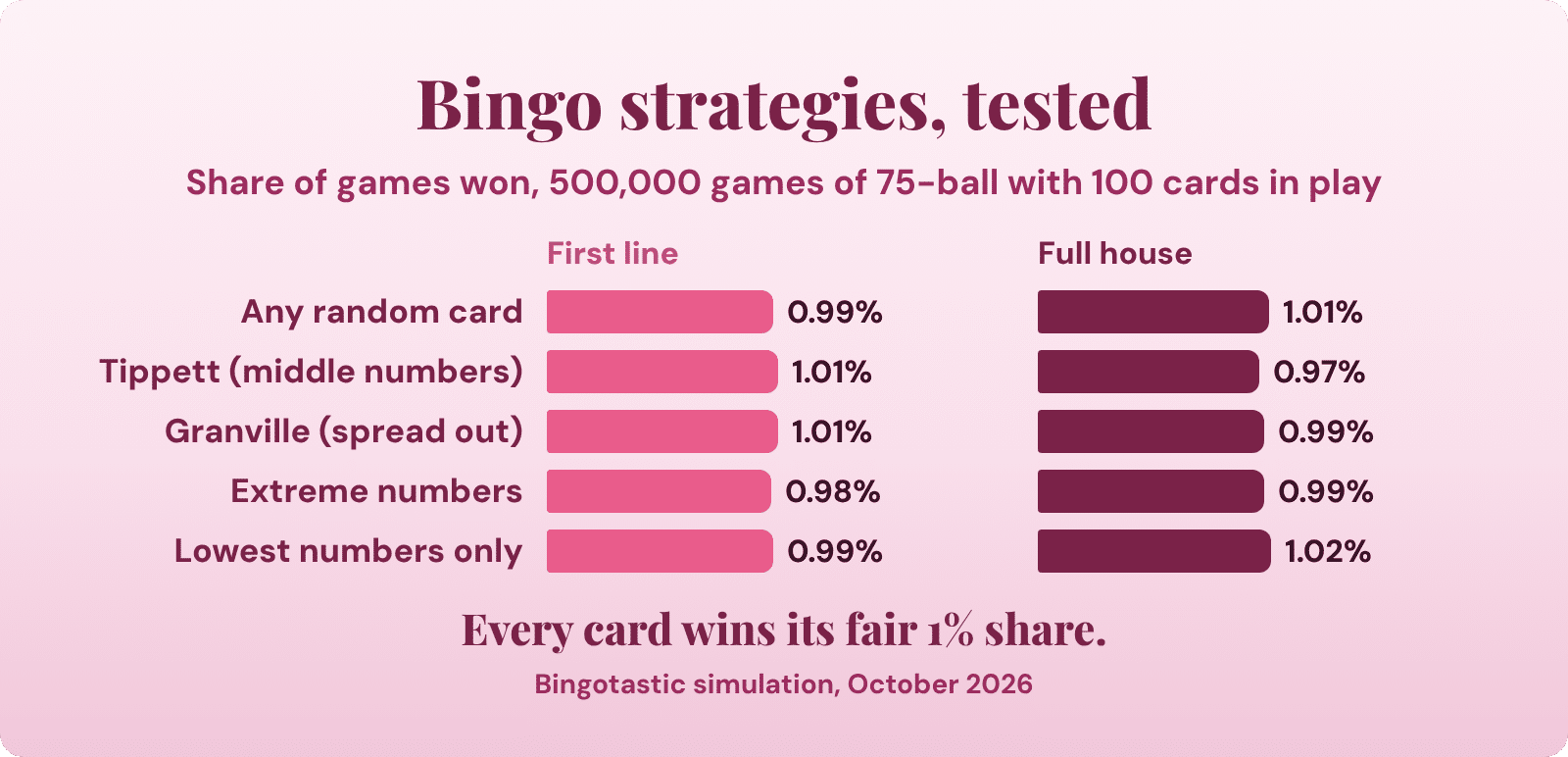
Both come from American 75-ball bingo, so we tested them there. We ran 500,000 games with 100 cards in play each time and gave each player a card built to that system. If a strategy worked, it would win more than its fair 1% share.
| Card strategy | Wins the first line | Wins the full house |
|---|---|---|
| Any random card | 0.99% | 1.01% |
| Tippett (middle numbers) | 1.01% | 0.97% |
| Granville (spread out) | 1.01% | 0.99% |
| Extreme numbers | 0.98% | 0.99% |
| Lowest numbers only | 0.99% | 1.02% |
They all land on 1%. The small differences in the second decimal place are just the wobble you’d get from any sample, and they flip direction from one column to the next. That’s what the maths says should happen. The balls don’t know which numbers are on your card, and every number is as likely as any other to come out next.
Online, the question rarely comes up anyway, because tickets are usually dealt to you. A few games let you swap them, such as tombola’s 80-ball game with its “swap boards” button, but a different set of numbers is still the same 1% chance.
Buying More Tickets
This one really does work, up to a point. Hold 10% of the tickets in a game and, over time, about 10% of the prizes will land on your tickets. We showed how closely wins follow ticket share when we looked at why the same players always seem to win.
The catch is the price. Ten times the tickets cost ten times as much, so you win more often but pay the same for every win. More tickets get you more of the same prize money, at the same price per win.
The Best Time to Play Bingo
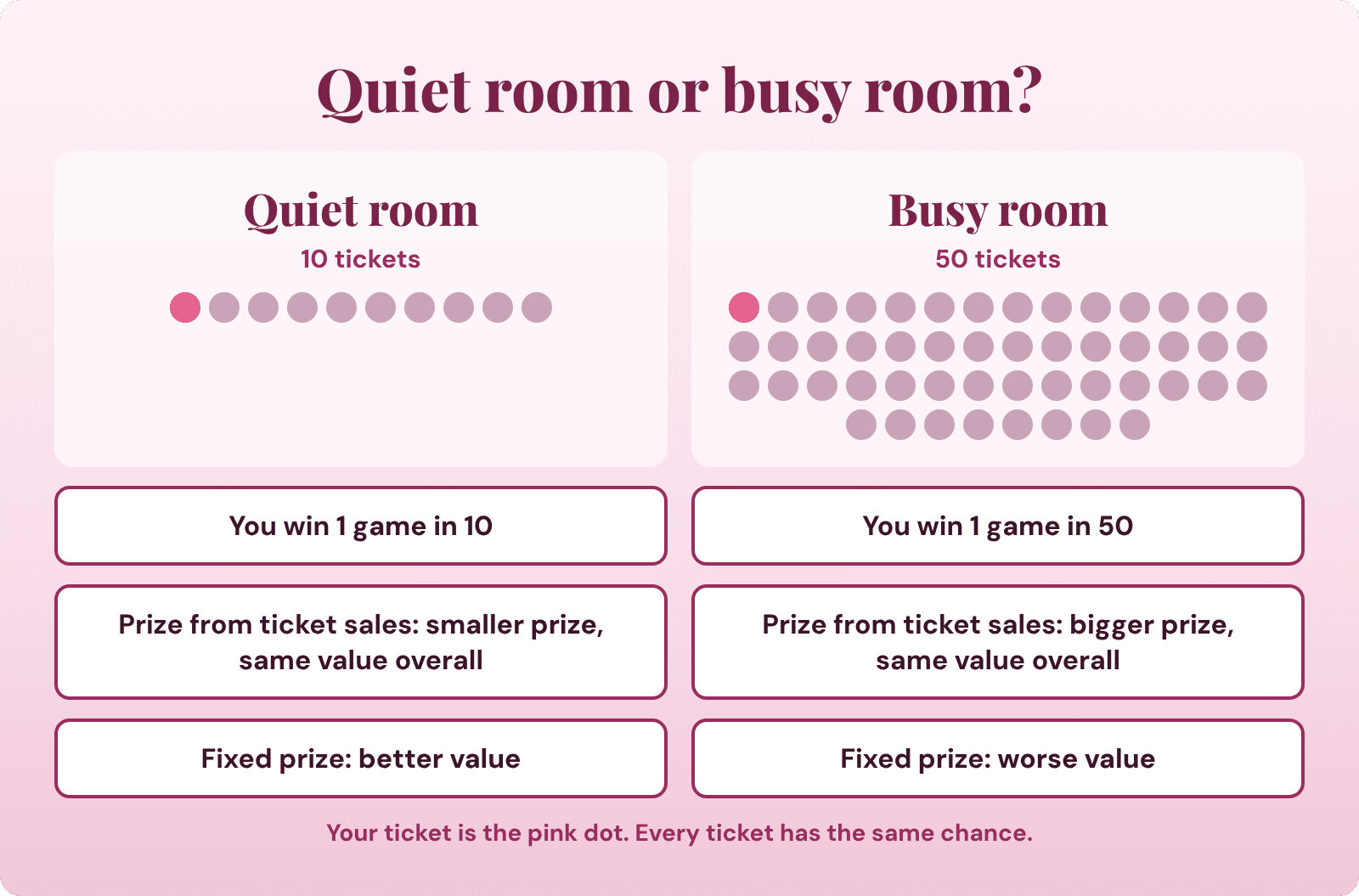
Fewer players means fewer tickets competing, so you win more often. Whether that matters depends on how the prize is set.
Most online rooms pay out a share of ticket revenue. When a room is quiet, fewer tickets are sold, and the prize shrinks to match, so you win more often but for smaller amounts. Over time, it evens out. The exception is a guaranteed prize, a fixed amount promised before the game. If ticket sales fall short, the site tops up the difference. Butlers Bingo’s terms say its payout rates go over 100% in exactly that situation.
Here’s how that works with two made-up rooms selling 10p tickets: one pays out 70% of ticket sales, and the other offers a fixed £10 prize. The last two columns show what you get back, on average, for every 10p ticket.
| Tickets in play | Your odds | Shared prize | Fixed £10 prize |
|---|---|---|---|
| 50 | 1 in 50 | 7p | 20p |
| 100 | 1 in 100 | 7p | 10p |
| 200 | 1 in 200 | 7p | 5p |
| 500 | 1 in 500 | 7p | 2p |
With a share-of-sales prize, player count doesn’t affect your average. With a fixed prize, a quiet game is better value and a busy one is worse.
In a local bingo hall, you can see the quiet times for yourself, because Google shows a “Popular times” chart for most clubs. We looked at Mecca Bingo Southend on a Wednesday. Its chart climbs through the afternoon and peaks in the evening, yet the club’s own schedule shows the quieter afternoon main session paying two £300 full houses, against a single £500 full house in the evening. Both cost £13 for eight electronic tickets. Fewer people chasing more prize money is about as good as bingo value gets, though Mecca’s terms do say prize guarantees can be withdrawn when something outside its control affects attendance.
Linked games are different. As their names suggest, Mecca’s Max Linked games and its National Game (£2.50 for five tickets, with a £250,000 prize) reach well beyond one club, and Buzz Bingo’s daily sessions run in its clubs and online. When players join from all over, how busy your hall is makes little difference.
Where the Real Value Is
If you want the best return on your money, look for the games where you’re not paying full price.
Free and newbie rooms. Rooms you can play without staking your own money are the only bingo where you can’t lose anything. Newbie rooms are open only to new accounts for their first days at a site, so the crowd is small, too. We keep a list of the newbie bingo rooms worth trying.
Undersold guarantees. A guaranteed prize in a quiet room, as above. These are worth watching for, though sites set guarantees based on rough estimates of who’ll turn up, so don’t expect many.
Penny rooms. They won’t make you rich, but cheap tickets make your budget last much longer. Our list of penny bingo sites has the ones that still run them.
Jackpots and Bonuses
Two things look like a shortcut to winning more, and both deserve a second look.
Jackpots that pay out if you finish within a set number of calls can have very long odds. Some big progressive ones work out to tens of millions to one per ticket, which we’ve covered in our guide to the types of bingo.
Welcome bonuses come with play-through rules attached, and at typical bingo payout rates, you can use a bonus up before you finish clearing it. Our guide to wagering requirements estimates what clearing one typically costs.
Online Bingo Tips That Help
Plenty of “tips” are really for halls. Online, the auto-dab marks every number for you, and tombola points out that a number still gets marked even if you miss it, so you don’t get a prize for paying attention. These are the tips we’d actually pass on.
- Check the room before you buy. Many lobbies show the ticket price and prize for the next game, and some show how many people are playing.
- Know whether the prize is fixed or shared. It’s the one thing that makes a quiet room better value.
- Set a deposit limit first. Licensed sites let you cap your deposits, take a break, or self-exclude. Mecca’s footer, for one, links to both net and gross deposit limits.
- Decide your budget per session, not per game. Online bingo games are quick, and small tickets add up faster than you’d think.
Bingo is a game of chance, and the best way to come out ahead is to enjoy it for what it is. Pick games that fit your budget, watch for value, and treat any win as a bonus, not a plan. New to the game? Start with how to play bingo.