Most bingo histories begin in 16th-century Italy and end in an American carnival tent. The British part of the story is stranger, and it’s mostly about buildings.
Bingo took over the nation’s cinemas in the 1960s, filled them for decades, and has been leaving them ever since. One of those halls, the Regal in Peterhead, is showing films again. Below, we’ve kept the early history honest by separating what’s on record from what’s simply repeated, and we’ve written the modern part based on our own research into every bingo hall in the country.
The Timeline
Where Bingo Came From
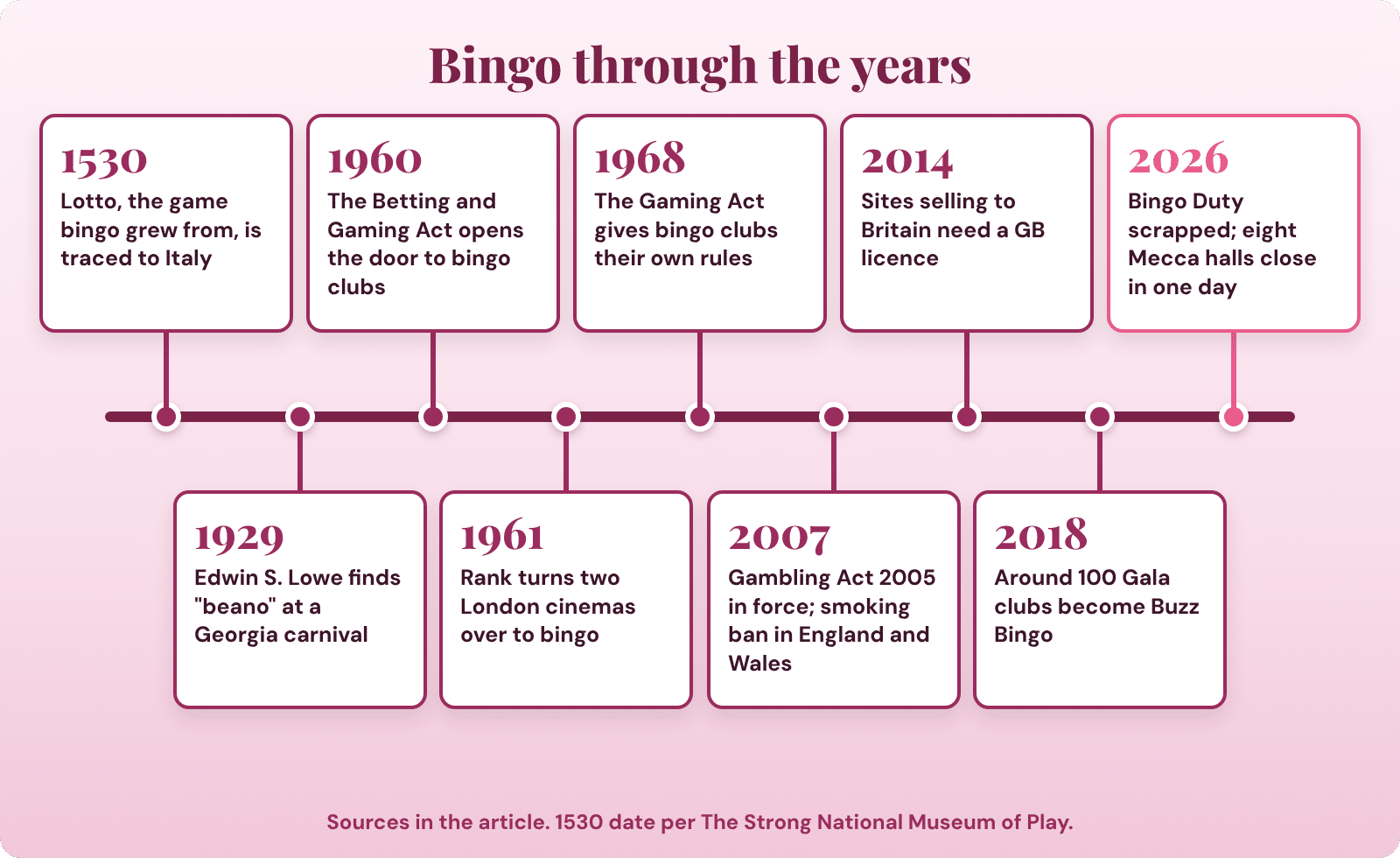
Bingo grew out of lotto, a numbers game from Italy. The date you’ll see everywhere is 1530. The Strong, the American museum of play, traces it to a game known as Lo Giuoco del Lotto de Italia and cites Merilyn Simonds Mohr’s book The New Games Treasury as its source. Most online bingo histories cite the same year without saying where it came from, so bear in mind that it rests on a game’s history rather than on a document anyone links to.
On firmer ground, the same museum says lotto had spread throughout Europe by the 19th century, and that spin-off versions using words and pictures were sold as educational games. The basic idea, drawing numbers at random and crossing them off a card until someone completes a pattern, existed long before the word bingo.
So, where did bingo originate? The game came from Europe, most likely Italy. The name, and the business of selling it, came from the United States.
Who Invented Bingo?
Nobody invented bingo from scratch, but one man named it and turned it into a product. According to The Strong, Edwin S. Lowe, a travelling salesman from New York, came across a packed carnival booth in Georgia in 1929. Players covered numbers on hand-stamped boards with beans in a game the stallholder called beano, adapted from a lotto game he’d played in Europe.
Lowe tried the game out on friends and began making bingo boards in the early 1930s. He paid a retired mathematician to calculate more than 6,000 number combinations for the cards, and churches and fraternal groups soon bought sets to raise money.
Then there’s the name. The story goes that one of Lowe’s guests got so excited at a win that they shouted “bingo” instead of “beano”. Even the museum introduces that one with “as the legend goes”, so enjoy it as a story rather than a recorded event. If you want a date for when bingo was invented, 1929 is the fairest answer for the American game and its name, with the game underneath it about four hundred years older.
How Bingo Came to Britain
Britain played the game before it had a name. The armed forces had their own version called housey-housey, and some of the bingo calls still heard today, including Doctor’s Orders, came home with the troops.
A change in the law turned a barracks pastime into a high-street business. The Betting and Gaming Act 1960 is the legislation that, in the words of the National Bingo Week history, opened up new possibilities for bingo as a business. Cinema chains quickly saw what a big auditorium full of seats facing a stage could do. In May 1961, Rank converted two large London cinemas to bingo: the Odeon on Hackney Road and the Gaumont in Peckham.
Towns up and down the country followed. Exeter’s Gaumont on North Street switched to bingo in 1963 and stayed that way for 63 years, as we found when we mapped the towns now left without a club. In Dartford, the Granada started hosting bingo in 1975.
The government soon tightened the rules. The Gaming Act 1968 included a section on bingo clubs, and it governed the halls until the Gambling Act 2005 took over. Under that system, clubs were members-only. You signed up, waited a day before you could play, and saw very little advertising.
The Bingo Hall Boom
By the 1980s, HMRC recorded around 1,360 bingo clubs in Britain, according to Full Fact. That’s nearly six for every one open today.
Because so many began as picture houses and theatres, some of the country’s finest interiors ended up hosting eyes down. Tooting’s Granada, opened in 1931, keeps a Grade I listed interior designed by Theodore Komisarjevsky and is still a bingo hall, often called the cathedral of bingo, as our look at how Buzz Bingo has refitted its halls shows. The Ritz in Grays, a Grade II listed building from 1940, ran as a bingo club for 36 years.
The prizes of the boom years were small by today’s standards. Under the old rules, jackpots couldn’t roll over and build into big sums, and when we researched the largest bingo wins in UK history, we couldn’t confirm a single £100,000 prize before late 2007. People went out for the evening to a local room full of familiar faces, with a modest win now and again on top.
The Long Decline: From 1,360 Clubs to 232
The fall began well before the internet. Full Fact found that the number of clubs halved between 1980 and 2000, and by 2005 the Bingo Association’s figure was down to 585.
Then 2007 changed the business twice over. The Gambling Act 2005 came fully into force that September, ending the members-only rules and letting clubs advertise. The smoking ban reached England and Wales the same year, following Scotland in 2006, and the Bingo Association told Parliament that a clear majority of its regulars smoked. As we set out in our cost-of-a-bingo-night study, clubs began to close.
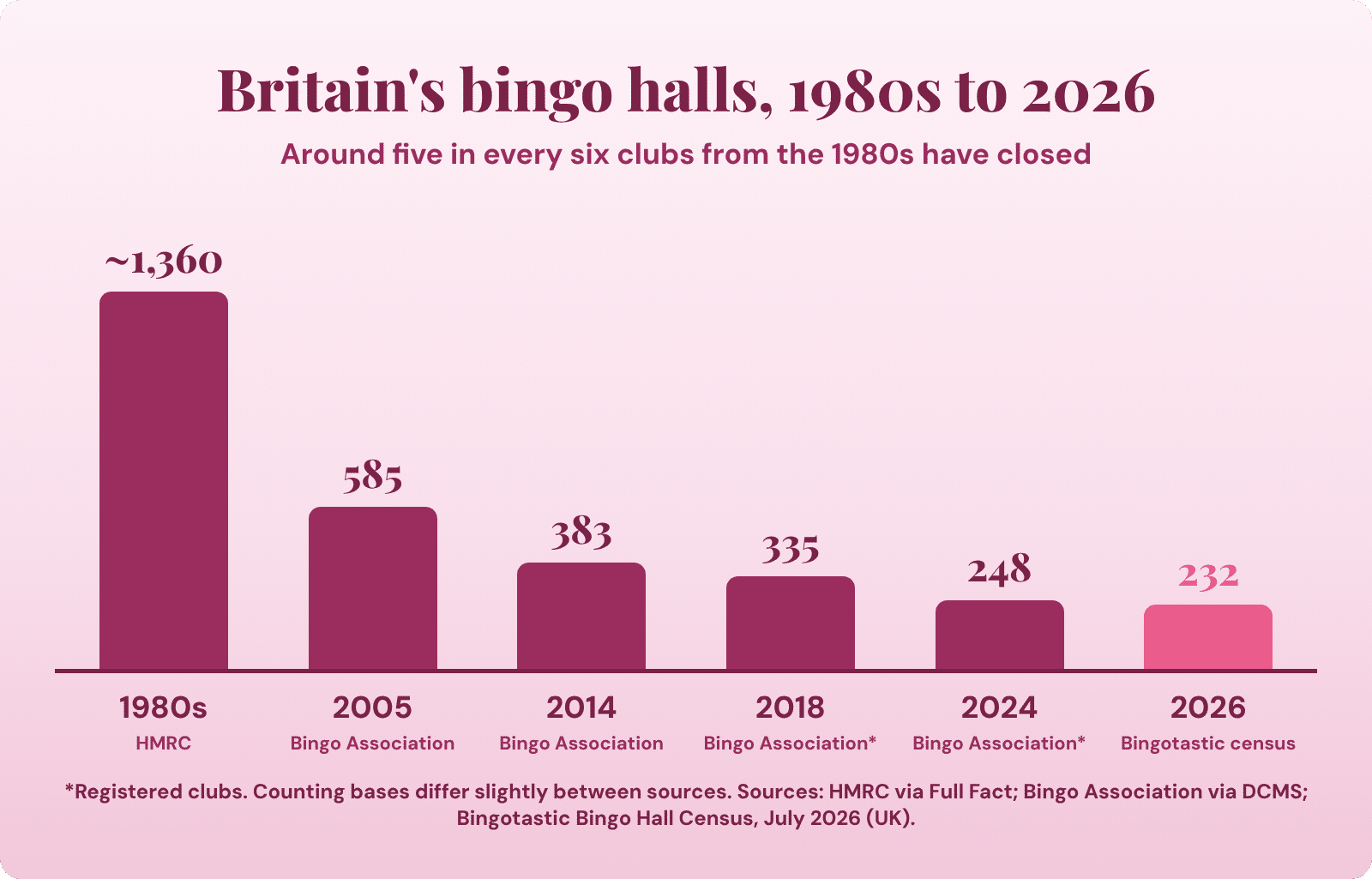
The trade body counted 383 clubs by 2014. In our Bingo Hall Census in July 2026, we found 232 traditional halls still open across the UK.
Lately, the buildings themselves often decide things. Mecca’s Scarborough hall, inside the Grade II-listed Capitol, closed in November 2025 when its lease ran out. Buzz Bingo left the listed former Granada in Shrewsbury in January 2026 after a developer bought the building. Our mapping found that 25.3 million people, 37.5% of Great Britain, are now more than five miles from their nearest club.
What Happened to the Old Halls
We traced 202 closed bingo halls to find out what each building is now, and the first surprise was that 92 of them never stopped playing bingo. Most simply changed their name in 2018, when around a hundred Gala clubs became Buzz Bingo.
Of the 110 where the numbers really did stop, most had no fate at all, with 37 standing empty or derelict. Others became flats, gyms, and venues. Dartford’s Granada is now Net Church, Andover’s old Mecca is a mosque, and in Dundee a former bingo floor hosts gigs. No fewer than 56 of the 202 started out as cinemas or theatres, and nine or more are listed buildings.
Only one has gone all the way back. Peterhead’s Regal opened as a cinema in 1939, spent its middle years as a Gala, and shows films again today.
The traffic hasn’t all been one way. In Hastings, a 1921 cinema called the Gaiety was restored over two years and came back in June 2025 as a bingo club, The Deluxe.
Bingo Goes Online
Online bingo gave the game a second home that doesn’t depend on a building. The rules caught up on 1 November 2014, when any site taking bets from British players had to hold a Gambling Commission licence, wherever the company was based.
The game itself barely changed. The 90-ball game of the halls sits online alongside 75-ball, 80-ball, and quicker formats, all covered on our types of bingo explained page, and if you’re new, how to play bingo starts at the beginning. What did change was the price of entry, with online tickets costing as little as a penny.
The two worlds also keep different calendars. Under section 183 of the 2005 Act, every premises licence carries a condition banning gambling on Christmas Day, so every hall shuts while the websites stay open. Some operators now straddle the two, and Buzz Bingo, for one, sells sessions open to players in its halls and on its website.
Bingo in 2026
Two big rule changes arrived in the first half of 2026. Local hall Bingo Duty, charged at 10%, was abolished on 1 April. Online, new Gambling Commission rules from 19 January cap the play-through on any bonus at ten times, which our guide to wagering requirements explains.
None of that stopped the closures. On Sunday 7 June 2026, Mecca closed eight halls, including Exeter, Taunton and Sunderland. Others are moving the opposite way. Club 3000 opened a club in Leeds in August 2025 and is building a £5m hall in Sunderland, in the shopping centre Mecca left. Buzz Bingo is in the middle of a £25m refurbishment programme announced in July 2025.