
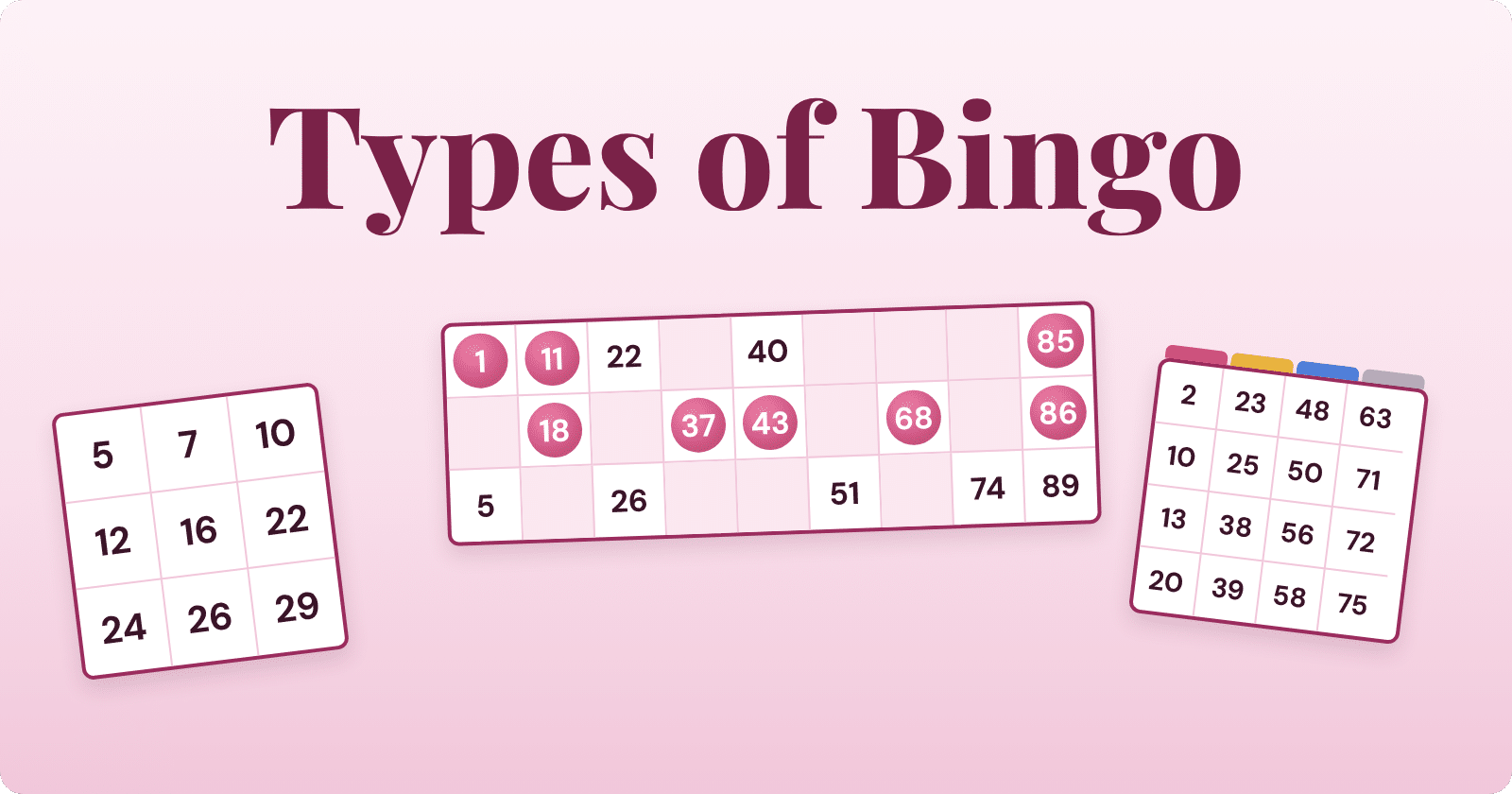
Most bingo in the UK comes in three sizes. Typically, they’re 90-ball, 80-ball, and 75-ball. Around them sit a handful of quick small-ticket games, a card-deck version, and many branded rooms that follow a standard fancy-dress format.
We’ve covered every type you’re likely to meet, how the ticket works, how long a game lasts, and the real odds on jackpots that only pay if you finish within a set number of calls.
Types of Bingo at a Glance
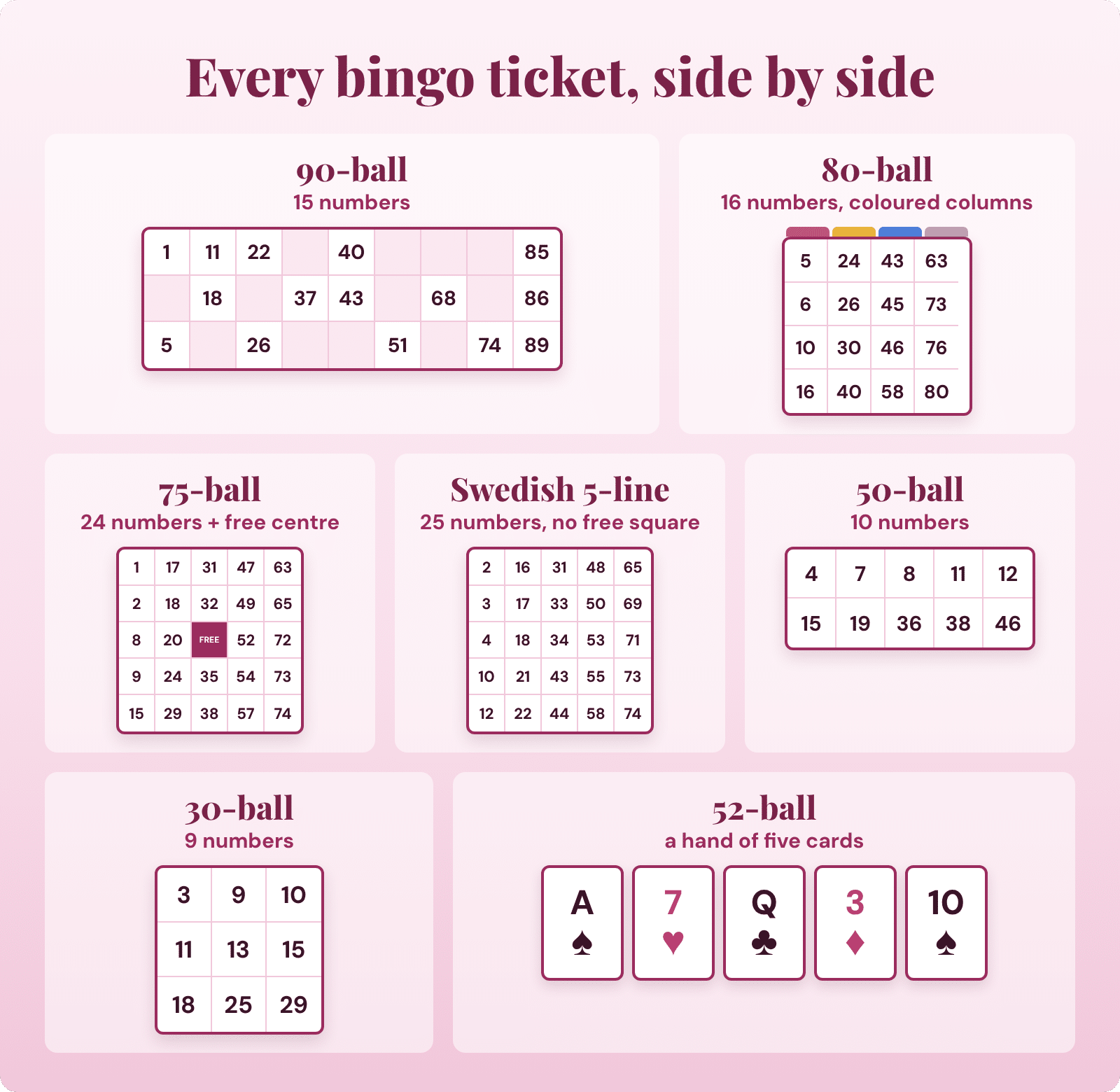
The number in the name is the count of balls in the draw. Fewer balls usually means a smaller ticket and a quicker game.
| Type | Numbers drawn | Your ticket | What you play for |
|---|---|---|---|
| 90-ball | 1 to 90 | 15 numbers over 3 rows and 9 columns | A line and two lines and the house |
| 80-ball | 1 to 80 | 16 numbers on a 4 x 4 grid | Lines or corners or a pattern and then the house |
| 75-ball | 1 to 75 | 24 numbers on a 5 x 5 card with a free centre | A pattern announced before the game or a run of line prizes |
| Swedish (5-line) | 1 to 75 | 25 numbers on a 5 x 5 card and no free square | Five prizes a game from one line up to the house |
| 50-ball | 1 to 50 | 10 numbers | A line and the full house |
| 40-ball | 1 to 40 | Several coloured tickets at once | A full house on each colour |
| 30-ball | 1 to 30 | 9 numbers on a 3 x 3 grid | The full house only |
| 52-ball | A deck of 52 playing cards | A hand of five cards | The full house only |
Bingo Tickets
90-Ball Bingo
A 90-ball ticket holds 15 numbers across three rows of nine columns, and each game pays three prizes as the ticket fills, starting with a single line.
Online, a strip is six tickets that share out all 90 numbers between them, so a full strip means you’ll mark a number on every single call. Our guide to how to play 90-ball bingo covers the rules, the ticket layout and what to expect from your first game.
80-Ball Bingo
Picture a 4 x 4 grid with 16 numbers and no blank squares. That’s 80-ball. Mecca’s version colours each column of the ticket, grouping the numbers in blocks of 20 so you can see at a glance which range a call belongs to.
What you’re playing for changes from room to room, which catches people out. Betfair’s rules list four game types, from a single prize for any line through to a four-prize game that pays for a line, two columns, three columns and the house. Its idea of a line is generous, too. Across, down and diagonal all count, and so do the four corners or the four middle squares.
Betfair groups 80-ball tickets into strips of five, which between them hold every number from 1 to 80. If 80-ball looks familiar from a night out, that’s because Mecca also plays its 80-ball Cashline Bingo between the main games in its clubs.
75-Ball Bingo and Pattern Games
75-ball is the version from across the Atlantic. The card is a 5 x 5 grid with BINGO spelt over its five columns and a free centre square, which leaves 24 numbers to mark.
The twist is the pattern. Before each game, the room shows the shape you need, which might be a single line, a diagonal, the four corners or the whole card (the American name for a full house is a blackout). Some rooms change the pattern every game, so no two in a row are the same. Our 75-ball rules walk through a game step by step.
Swedish bingo uses the same 75 balls but drops the free square, so all 25 squares have numbers. Instead of one pattern, you play for five prizes in every game. Robin Hood Bingo pays for one, two, three, and four lines, plus the house. Some sites call this 5-line bingo. At Kitty Bingo, the 75-ball Deal or No Deal room plays the same five-line prizes, but with its free centre left in. Any direction counts for the first line, and the next four must run across the card.
50-Ball and 40-Ball Bingo
A 50-ball ticket carries just 10 numbers, and you play for a line and the full house. Mecca keeps three spin-offs in its 50-ball section. Emoji Bingo swaps numbers for emojis, Burst Bingo features animals holding numbered balloons that pop when called, and Clover Rollover collects coins as you mark numbers, with a jackpot for the full house.
tombola does it differently. Its bingo50 always gives you five tickets, and the stake you choose (25p to £1) decides prize size rather than how many tickets you hold.
40-ball is rarer still. The one version we found calls numbers from 1 to 40 and gives you four coloured tickets, pink, black, amber, and teal, each paying its own full-house prize. Each colour also has its own jackpot target, from 4 calls on pink to 22 calls on teal, with the top prize reaching £10,000 at a £2 stake.
30-Ball and Other Speed Games
30-ball is the quickest numbered format. The ticket is a 3 x 3 grid of nine numbers, with one prize: the full house. At tombola, bingo30 tickets cost 10p, up to 20 a game, with around 25 games an hour.
It also comes with one of the more generous jackpot rules we’ve seen. Clear a ticket within 11 calls and you win £1,000, and the jackpot is never shared, so if two players do it in the same game, each gets the full amount.
Sun Bingo has its own 36-ball game. Its Winning Headlines room runs from 10p, Monday to Saturday between midday and 11pm.
52-Ball Bingo
52-ball bingo swaps the balls for a deck of playing cards. You buy a hand of five cards, the game draws cards from a standard 52-card deck, and you mark off each one you hold. Robin Hood Bingo marks them with chips rather than a dabber.
With only five to find, there’s one prize per game, the full house. Robin Hood points out that you can play several 52-ball games in the time it takes one 90-ball, or Swedish, game. Wink Bingo’s lobby lists Bingo Deal and Woolly Bingo as 52-ball rooms.
How Long Each Type of Game Lasts
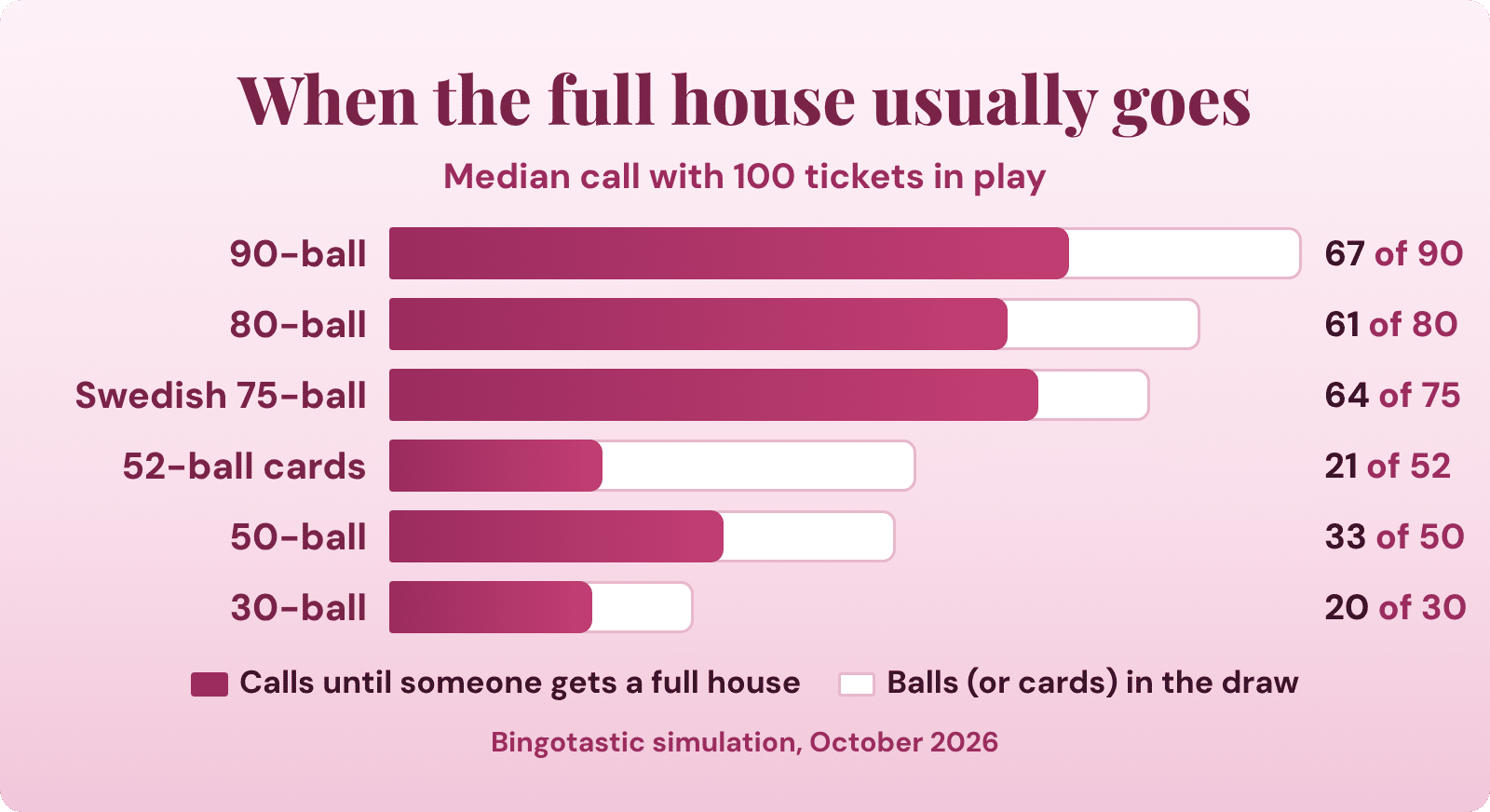
Nobody we read puts a number on this, so we simulated it. For each format, we ran 3,000 games at three room sizes (1,500 for 90-ball, using proper strips of six) and noted the call on which someone completed a full house. Each figure is the median, the middle result across all those games.
| Type | 20 tickets in play | 100 tickets | 500 tickets |
|---|---|---|---|
| 90-ball | 73 | 67 | 61 |
| 80-ball | 67 | 61 | 56 |
| 75-ball Swedish | 68 | 64 | 61 |
| 50-ball | 37 | 33 | 29 |
| 30-ball | 22 | 20 | 17 |
| 52-ball (5 cards) | 28 | 21 | 16 |
The big tickets all take most of the draw, even in a busy room, so an 80-ball house usually needs around 60 of the 80 calls. And 52-ball changes the most with the crowd. A single hand typically needs 46 of the 52 cards, but with 500 hands in play, someone finishes by about the 16th.
We’ve kept to calls rather than minutes, because minutes depend on how fast each room calls.
Jackpot Games
Bingo jackpots come in two kinds, and they behave very differently.
A progressive bingo jackpot grows from a share of ticket sales until somebody wins it. Kitty Bingo’s Jackpot 75, in its Deal or No Deal room, starts at £3,000 and needs a full house within 43 numbers. Mecca’s Cashline Bingo has a twist on the idea. Its Elevator jackpot, starting at £2,500, goes to a house in 32 calls or fewer, and half is shared among everyone holding tickets in that game.
A fixed call-limit jackpot pays a set amount if you finish within a stated number of calls. The first four rows below are fixed jackpots on tombola’s own games.
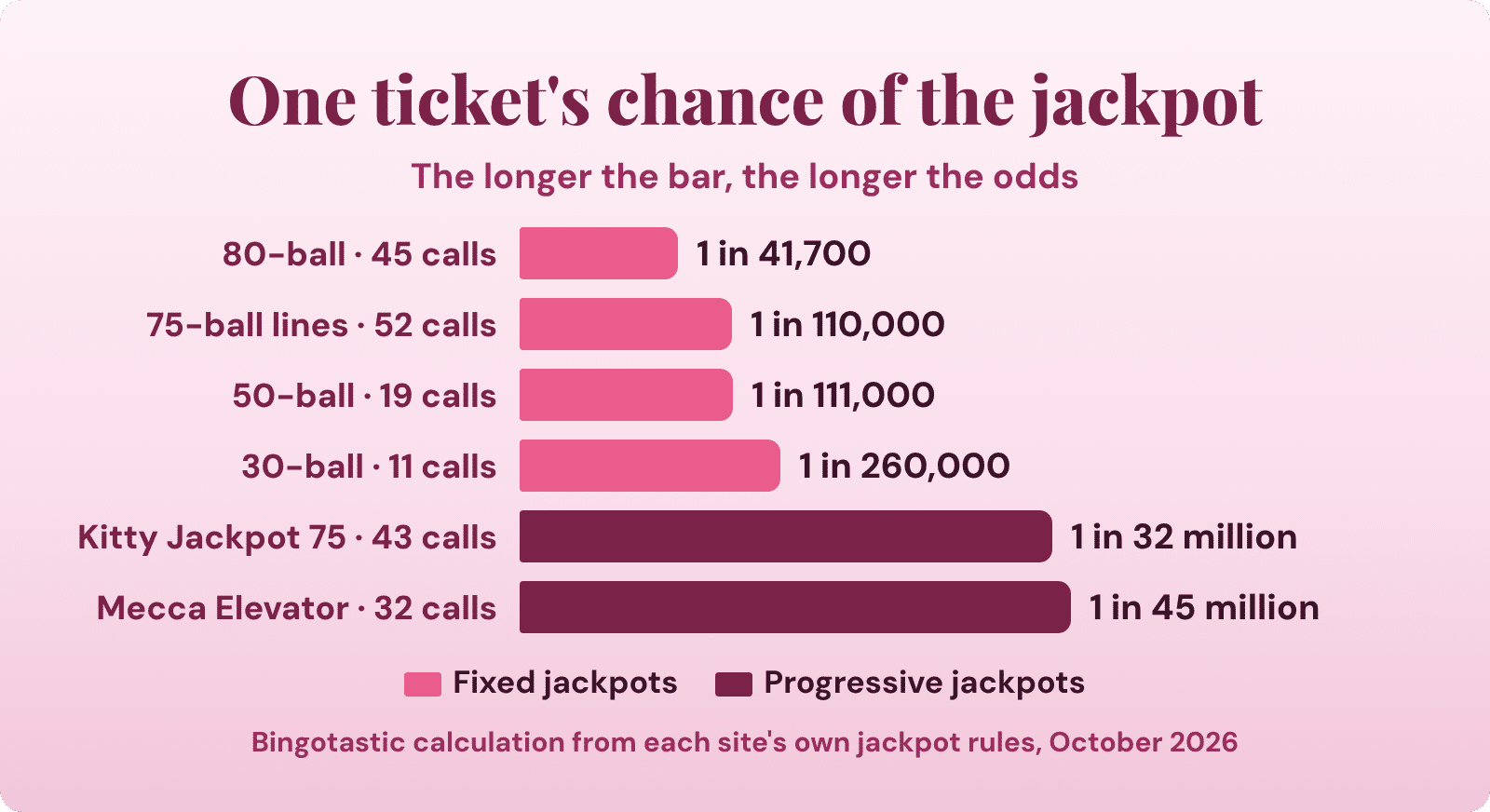
The call limit determines the odds, so we worked out the chance of a single ticket hitting each one.
| Jackpot | What you need | Chance per ticket |
|---|---|---|
| 80-ball (£500) | Full house in 45 calls | About 1 in 41,700 |
| 75-ball lines (£1,000) | All 25 numbers in 52 calls | About 1 in 110,000 |
| 50-ball (up to £1,000) | All 10 numbers in 19 calls | About 1 in 111,000 |
| 30-ball (£1,000) | All 9 numbers in 11 calls | About 1 in 260,000 |
| Kitty Bingo Jackpot 75 (from £3,000) | Full house in 43 numbers | About 1 in 32 million |
| Mecca Cashline Elevator (from £2,500) | Full house in 32 calls | About 1 in 45 million |
The fixed jackpots are set at odds a busy room can hit regularly (the 30-ball game averages two jackpot wins a day), so they can be fixed sums. The progressives sit at odds in the tens of millions per ticket, so they can climb for a long time before anyone gets near them. Kitty raises the call target as the pot grows, which shortens those odds over time.
None of this changes your chance in the game itself. Every ticket in a room has the same shot at the line and the house, which we’ve explained in more detail in our is online bingo rigged article.
Deal or No Deal and Friends Branded Rooms
Many rooms with famous names use standard formats with an added bonus feature. Deal or No Deal Bingo is the best known. Kitty Bingo runs it as a 75-ball line game with a chance to beat the banker for an extra prize, and Sun Bingo also has a 75-ball version.
Mecca’s special rooms take the same approach with 90-ball. In Snakes and Ladders Bingo, a full house unlocks a board where you roll the dice three times, with £500 at the top. X Factor Bingo hides a special ticket behind the judges’ table that pays the biggest prizes if you complete it.
A few other games share the name without sharing the format.
- Live bingo. Buzz Bingo runs four-session games a day that you can play in its clubs or online, plus a live-hosted room.
- Slingo. Slot-style reels feeding a bingo grid. We’ve rounded up the Slingo sites worth a look.
- Video bingo. You play it solo, with no room or chat, and it feels more like a slot machine than a bingo hall. We cover it separately under video bingo.
Which Type of Bingo Should You Play?
It mostly depends on how much time you have and what you want from the room.
If it’s chat and a long evening on a small budget, 90-ball is still the best option. The games last the longest, each has three prizes, and our penny bingo sites list rooms where tickets cost a penny.
For more chances per ticket, Swedish or 5-line rooms pay five prizes per game instead of three. Short on time? 30-ball and 52-ball games finish in a fraction of the calls, though each has only one prize.
And if it’s the jackpots that tempt you, check the call limit before you buy. As the table above shows, the jackpots you need to win within 11 calls and within 52 can be far apart.