
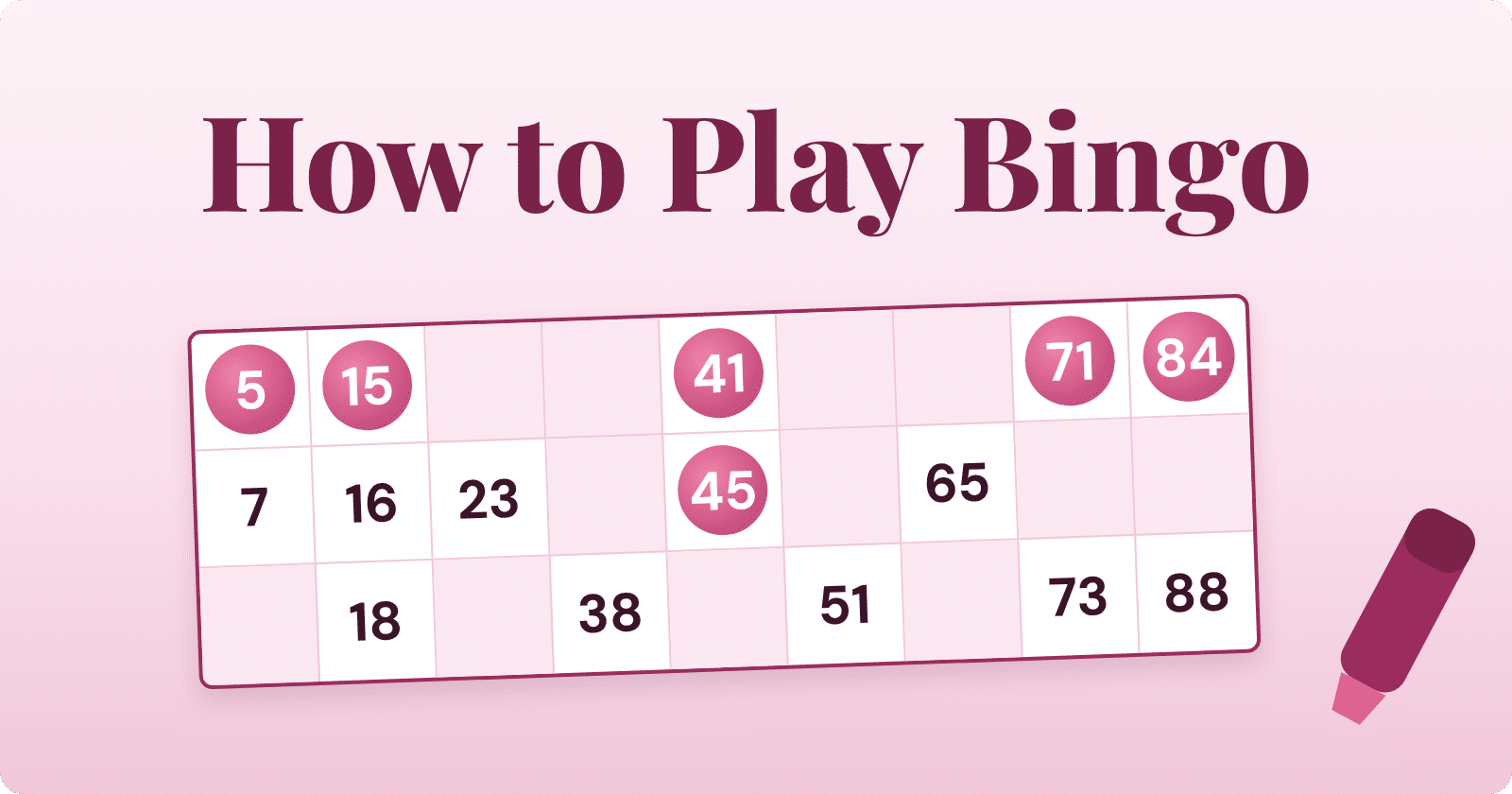
Bingo is the easiest game to learn. Play one game, and you’ll get it!
The only real confusion comes from the fact that there are two main versions, and the one you’ve seen on American telly isn’t the one played in British halls. Here in the UK, the classic is 90-ball. In the States it’s 75-ball. This guide walks through both, with pictures of the tickets, so you’ll know exactly what you’re looking at before you buy a single one.
How a Game of Bingo Works
Every version of bingo follows the same basic pattern, whether you’re in a Glasgow hall or playing on your phone.
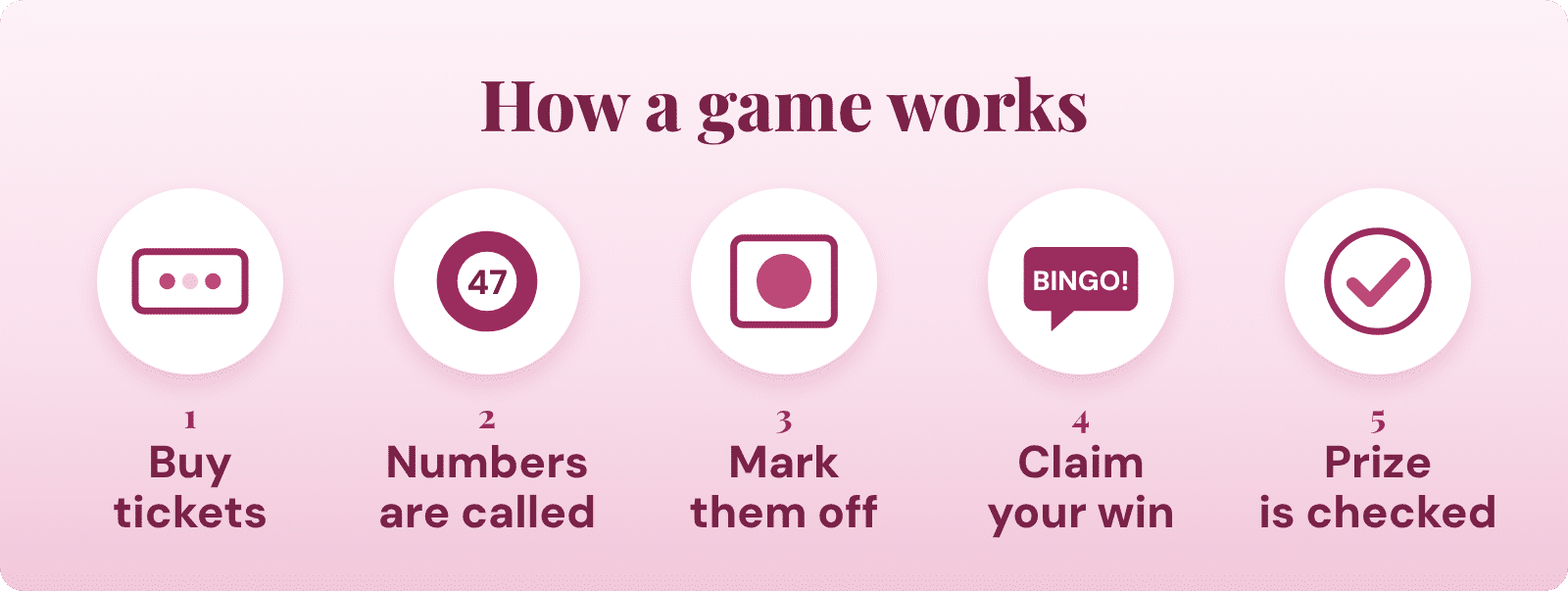
- You buy one or more tickets. Each ticket carries a set of numbers you didn’t choose.
- A caller draws numbers at random and reads them out, one at a time.
- You mark off each called number that appears on your tickets.
- When a ticket completes the pattern the game is playing for, you claim.
- The claim is checked, and if it’s right, the prize is yours.
That really is all there is to it. The Gambling Commission still uses a description written by a Royal Commission in 1978, and it still holds up. Bingo, it says, is “a lottery played as a game”. You get numbers you didn’t pick; they’re marked off against numbers drawn at random, and the winner is whoever can first prove they’ve matched the lot, or the particular section being played for.
What changes from game to game is the ticket, how many balls are in the drum, and what counts as a win.
How to Play 90-Ball Bingo
This is British bingo, the version played in clubs across the country. The balls run from 1 to 90.
The 90-ball ticket
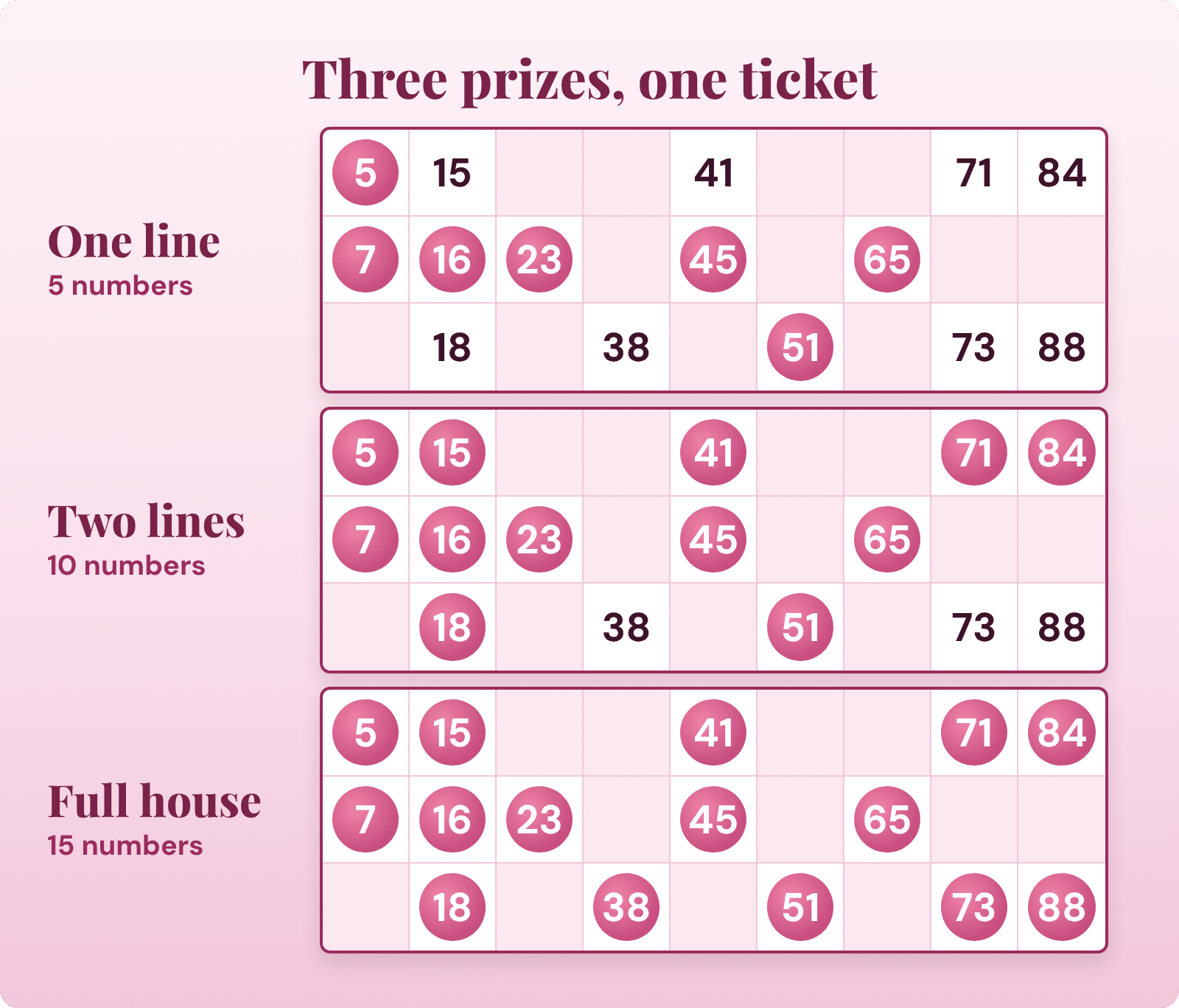
A 90-ball ticket has three rows and nine columns. Each row holds five numbers and four blank squares, so every ticket carries 15 numbers in total.
The columns aren’t random. The first column holds only numbers from 1 to 9, the second holds 10 to 19, the third 20 to 29, and so on across the ticket until the ninth column, which holds 80 to 90. Once you know that, finding a number is quick. If the caller says 47, you look straight down the fifth column and nowhere else.
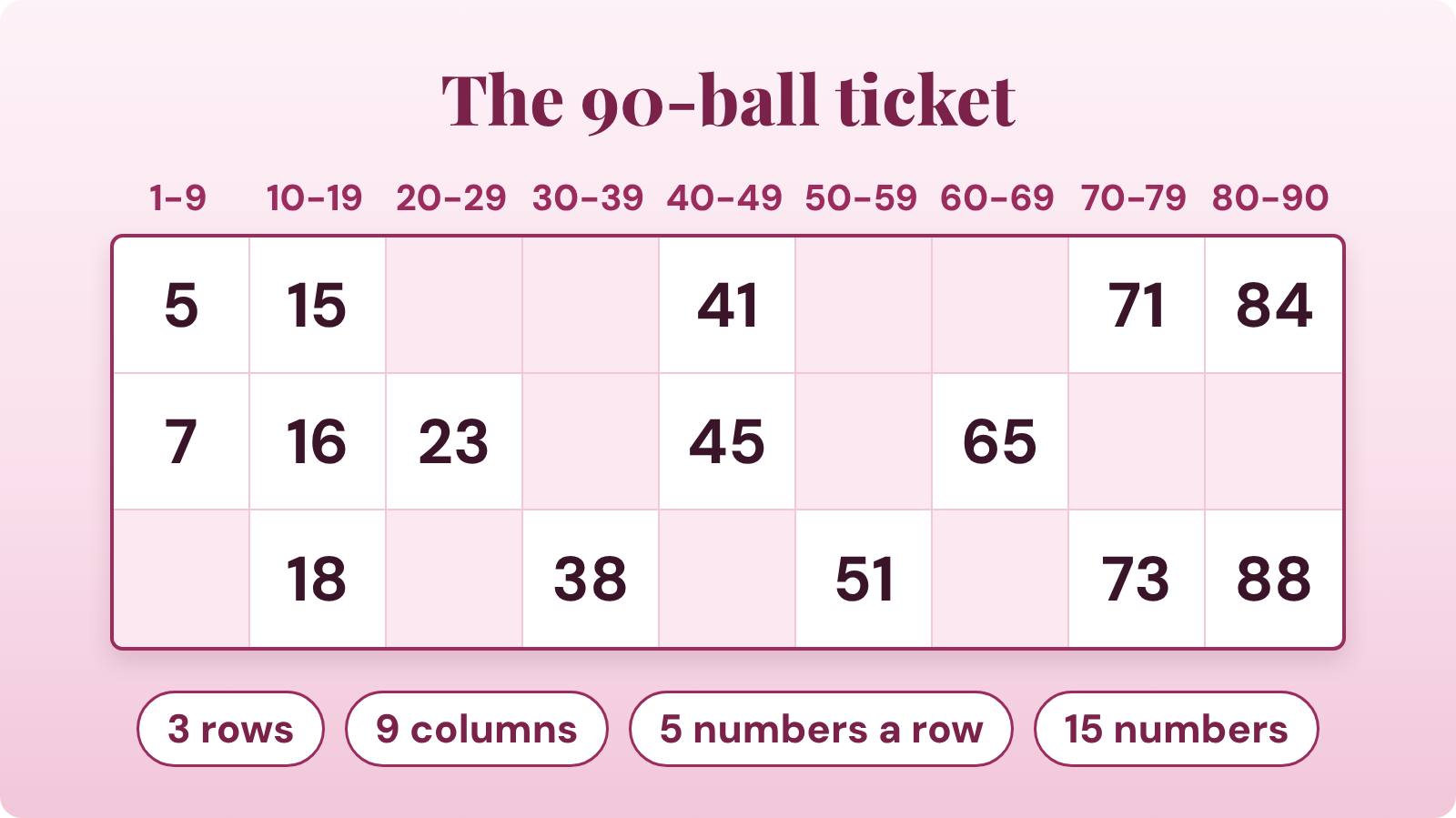
Because there are only three rows, a column can never hold more than three numbers on a single ticket, and some columns will be completely empty. That’s normal. A ticket with a blank 80s column isn’t faulty; it just means you’ll be sitting out the top of the range.
Why tickets come in strips of six
90-ball tickets are usually sold in strips of six. A proper strip is built so that every number from 1 to 90 appears exactly once across the six tickets. No repeats and no gaps.
The practical upshot is that if you play a full strip, every single number the caller reads out will be on one of your tickets. You’ll be marking something on every call. With a single ticket you hold 15 of the 90 numbers and spend most of the game waiting.
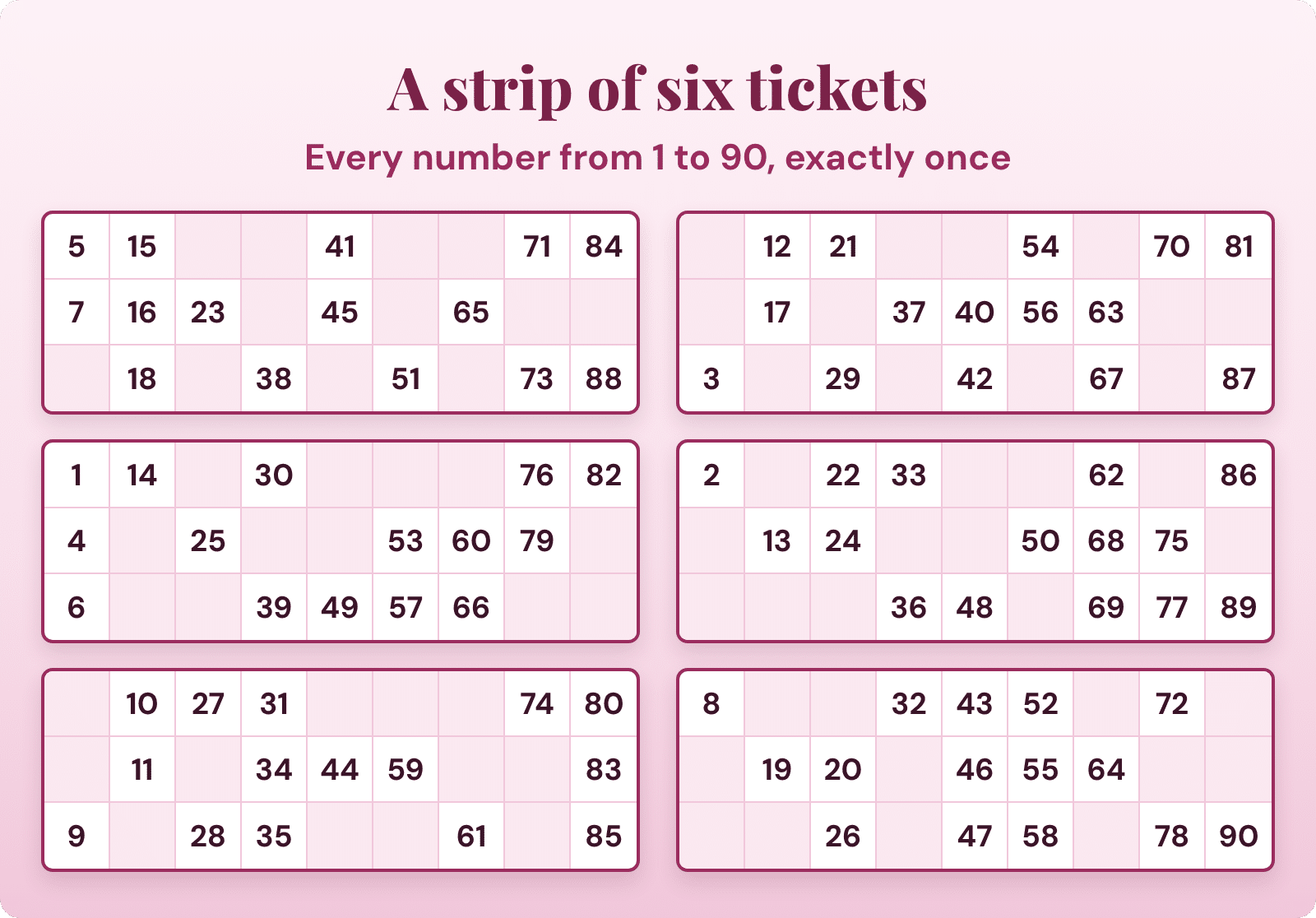
Our bingo card generator prints strips built to the same rule, so if you want to see one on paper, it’ll do you as many as you like.
The three prizes: one line, two lines, full house
A 90-ball game is played for three prizes in turn, all on the same set of tickets.
- One line. All five numbers on any one row of a ticket.
- Two lines. Any two rows on the same ticket, so ten numbers.
- Full house. All 15 numbers on a ticket. This is the big one.
The game doesn’t stop after the first winner. Once the line is claimed and checked, play continues straight for two lines, then for the house. If two or more players complete the same prize on the same number, they usually split it.
How to Play 75-Ball Bingo
75-ball is the American game, and it plays quite differently. Plenty of UK bingo sites run it alongside 90-ball, so you’ll come across it sooner or later.
The 75-ball card
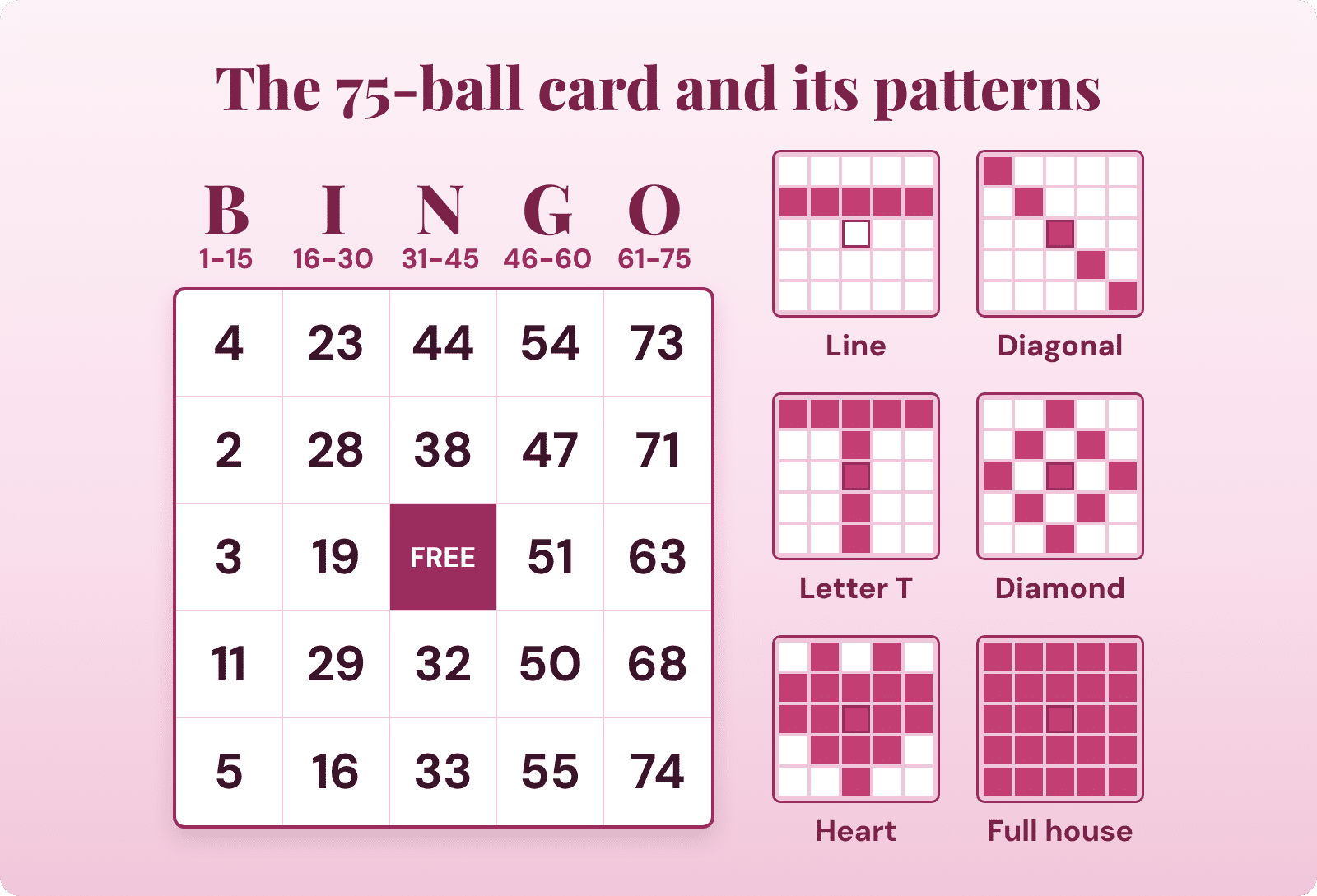
Instead of a long thin ticket, you get a square card of five rows and five columns, with the letters B, I, N, G and O across the top. Each letter has its own range of numbers.
- B covers 1 to 15
- I covers 16 to 30
- N covers 31 to 45
- G covers 46 to 60
- O covers 61 to 75
The square right in the middle is a free space. It counts as marked from the start, which leaves 24 numbers on the card.
Patterns instead of lines
This is the bit that throws British players. A 75-ball game is played for a pattern, and the pattern is announced before the first ball comes out. It might be a straight line, a letter, a diamond, a heart, or the whole card (a full house, sometimes called a blackout). Some rooms run a different pattern every game, which is half the fun.
A straight line can run across, down or diagonally. Some games even pay out for half a pattern before the full shape is done (Gala runs a few like that), so read the room’s prize list before the game starts.
Is bingo four or five in a row?
It depends on which game you’re playing. In 75-ball, a line is five in a row. But if the line runs through the middle of the card, the free space counts as one of the five, so you only need four called numbers to finish it. That’s where the “four in a row” idea comes from.
In 90-ball there’s no free space and no diagonal. A line is all five numbers across one row of a ticket, gaps and all.
Other Versions You’ll See
Online bingo has spawned a handful of quicker formats. Most focus on speed, with smaller cards and fewer balls, so a game ends in a minute or two. The grids differ from site to site for some of these, so treat the table as a guide to what you’ll typically find.
| Game | The card | How you win |
|---|---|---|
| 90-ball | 3 rows x 9 columns with 15 numbers | One line then two lines then full house |
| 80-ball | 4 x 4 with 16 numbers and no blanks | Lines and patterns set by the room |
| 75-ball | 5 x 5 with a free centre (24 numbers) | A pattern announced before each game |
| 50-ball | 2 x 5 with 10 numbers (a Gala format) | A line or a full house |
| 40-ball | 2 x 4 with 8 numbers | A clover pattern then a full house (Rainbow Riches Bingo) |
| 30-ball (speed bingo) | 3 x 3 with 9 numbers | Rules vary by site. Rounds are over in minutes |
Then there’s video bingo, which is a different animal altogether. You play it alone, against the game rather than a room full of people, and it behaves much more like a slot. If you want a fun and social game, stick to the formats above.
How Long Does a Game of Bingo Last?
None of the guides we read gave a direct answer, so we worked it out ourselves. We simulated 1,500 games of 90-ball at each room size, using tickets built in proper strips of six, and recorded the call on which each prize went. The table shows the typical (median) call at each room size.
| Tickets in play | Line usually goes on call | Full house usually goes on call |
|---|---|---|
| 6 (one strip) | 47 | 79 |
| 60 | 31 | 69 |
| 300 | 23 | 63 |
| 1,200 | 18 | 58 |
The full house holds on for longer than most people expect. Even in a busy room, roughly two-thirds of the balls are called before anyone fills a ticket.
A single ticket has it harder still. On its own, a 90-ball ticket typically needs 87 of the 90 numbers to fill, which is why the house almost always goes to somebody else’s ticket in a crowded room.
75-ball runs to a similar rhythm. With 200 cards in play, a blackout usually needs about 62 of the 75 balls.
How that translates into minutes depends on the caller. Buzz Bingo runs a hall game in about ten minutes, while online rooms call much faster and can finish a game in about a minute.
Playing Bingo Online
The game itself is identical online. What changes is everything around it.
- You buy before the game starts. Rooms run games on a schedule, and you pick your tickets or strips for each one. Once the first ball is drawn, you can’t cancel.
- Auto-daub does the marking. The site marks your numbers as they’re called, so you can’t miss one. Your closest tickets move to the top of the screen.
- The countdown tells you how close you are. 1TG means one number to go, 2TG means two. Our bingo calls page has the rest of the chat shorthand.
- Wins are paid automatically. There’s no shouting. If your connection drops mid-game, both Mecca and Gala say they play your tickets on and credit any win.
- Rooms can show you the numbers. Some sites, Gala for one, display how many players and tickets are in a room before you buy. That’s handy to know, as the table above shows.
The chat room is what surprises new players. Plenty of rooms have a chat host running quizzes and chat games while the numbers roll, and it can be a friendly place to learn. If you’re starting from scratch, our guide to newbie bingo rooms covers the sites with beginner-only rooms, and penny bingo keeps learning cheap, with tickets from a penny. One thing to check on any welcome offer is the wagering. Since 2026, UK sites can’t require you to play bonus money more than 10 times, and lower is better for bonus wagering requirements.
Playing in a Bingo Hall or at the Pub
Hall bingo is where it all started, and 232 traditional halls were still open across the UK in July 2026, according to our 2026 hall census. If there’s one near you, our bingo halls directory will find it.
The game is the same 90-ball you’ve just read about, with a few physical differences. You’ll buy a book of tickets for the session, with a page for each game, and mark them off with a dabber (a fat felt-tip pen that leaves a coloured blot). Some clubs, Palace Bingo in London among them, also let you play on a tablet that marks the numbers for you, much like auto-daub online.
The biggest difference is the claim. Nobody checks your paper tickets for you, so when you complete a line or a house, you have to call it out loud and clear. “Bingo!” does the job, and you’ll hear “house!” too. They then check your ticket against the numbers called before paying the prize. Be quick about it. The Gambling Commission requires every game to have a clear end point, including the claim window, and at venues like Palace Bingo, if you don’t shout in time and the next number is called, you lose the claim.
If you’d like to know what a night out costs before you go, we priced it up in the cost of a bingo night.
Bingo at the pub or a club
Many pubs and social clubs run bingo nights, and the rules are lighter. Under Gambling Commission guidance, a pub or members’ club can run bingo without an operating licence as long as stakes and prizes stay within £2,000 in any seven days, and a pub can’t charge a separate participation fee on top. Anything bigger needs a licence. If you’re thinking of running one yourself, check the Commission’s guidance for pubs and clubs.
For a home game with family or friends, our card generator prints the tickets, and the bingo calls page has a printable caller’s sheet.
Bingo Etiquette
Bingo has a few unwritten rules, and regulars notice when you break them.
In a hall, keep the chatter down while numbers are being called. People are concentrating, and nobody wants to miss 62 because you were describing your new kitchen. If you can help it, don’t sit in a regular’s seat (some of them have been in the same spot for years). Claim clearly and promptly rather than half-raising a hand, and if you’re not sure you’ve won, call anyway and let the checker sort it out. A false claim isn’t a crime, just a bit embarrassing.
Online, the etiquette lives in the chat. Say hello, be nice to the host, and congratulate the winners. A quick “WD” (well done) is the done thing. Don’t beg for bonuses, go on about your losses, or spam the chat while a game is running.
Can You Get Better at Bingo?
Honestly, no. There’s no system and no skill to it. In Britain, the law actually requires it to be that way. The Gambling Commission says bingo must be an equal-chance game, with no staking against the house, and every ticket must have the same probability of success. Your ticket and the one next to you have exactly the same shot.
You control only how many tickets you play and which games you pick. More tickets cover more numbers, but they cost more, so it’s a trade rather than an edge. Quieter rooms have fewer people, but the prizes tend to be smaller to match, and as the table above shows, the game also runs longer before anyone wins.
So treat it like a night out. Decide what you’re happy to spend before you start, stick to it, and enjoy the game for what it is. Online, you can set deposit limits on your account (Gala, for one, offers daily, weekly and monthly ones), and they’re worth using from day one.
Bingo Words You’ll Hear
A short glossary for your first few games. For the number nicknames, Kelly’s Eye and all the rest, see our full list of bingo calls from 1 to 90.
- Auto-daub. The online setting that marks your numbers for you.
- Blackout. The 75-ball version of a full house, every square on the card.
- Book. A hall’s pack of paper tickets, one page per game in the session.
- Caller. The person (or computer) who reads out the numbers.
- Card. Often used for a 75-ball grid; 90-ball ones are usually called tickets.
- Checker. A staff member who verifies a claim in a hall.
- Dabber. The marker pen used on paper tickets.
- Free space. The centre square on a 75-ball card, marked from the start.
- Full house. Every number on a 90-ball ticket, and the top prize.
- House. What you shout when you’ve got one.
- Line. One complete row of five numbers.
- Linked game. One game played across several clubs or sites at once for a bigger prize.
- Session. A run of games played back-to-back, usually in a hall.
- Strip. Six 90-ball tickets covering numbers 1 to 90.
- TG. Short for “to go”. 1TG means you’re one number away.
Ready for Your First Game?
If you want to try it at home first, print a strip from our bingo card generator, grab a bag of numbers and a caller with a bit of patience. If you’d rather go straight online, the newbie rooms are the gentlest way in, and our mobile bingo sites guide covers playing on your phone. Either way, you’ll have the hang of it by the second game.