

Watch the same name win three games in a row, and it’s hard not to wonder. So here’s the short answer. Licensed UK bingo isn’t rigged, and the rules that prevent it are much more specific than “it’s regulated”.
Below, we’ve laid out what those rules actually say, who checks them, and why the same handful of players seem to win all the time. That last one has a perfectly boring explanation, and we ran the numbers to prove it.
How Online Bingo Numbers Are Drawn
In a hall, you can watch the balls come out of the machine. Online, a random number generator (RNG), software that picks each number with no pattern anyone could predict, does the draw.
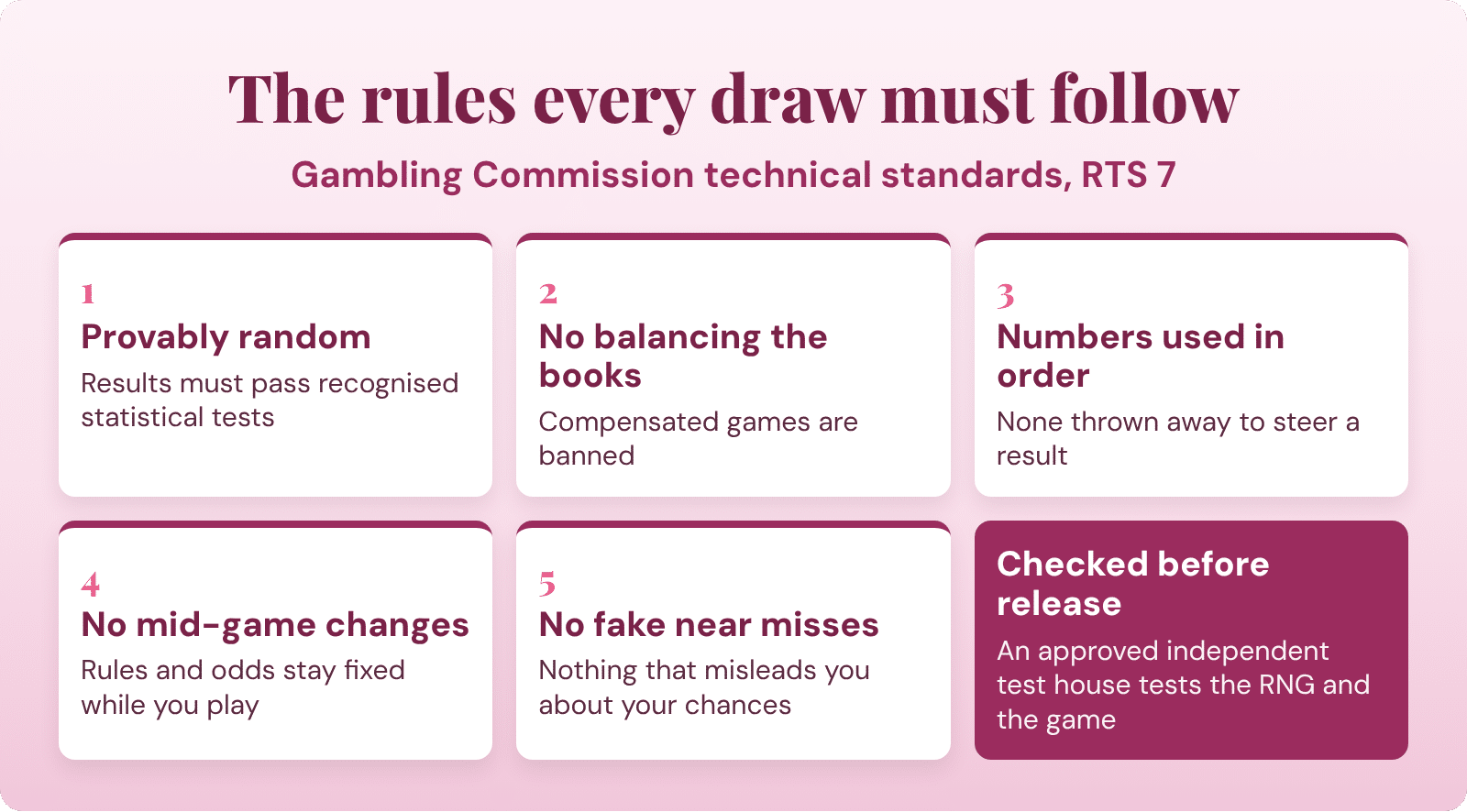
That alone wouldn’t settle anything, so the Gambling Commission sets out what the RNG must do in its technical standards for online gambling. The rules are worth reading in the original, because they’re blunter than you might expect.
- The results must be provably random. It must be possible to show “to a high degree of confidence” that outcomes are random, using recognised statistical tests.
- No balancing the books. “Adaptive behaviour (that is, a compensated game) is not permitted.” A game can’t quietly tighten up because players have been winning, or loosen up to keep you playing.
- No cherry-picking numbers. Random numbers must be used “in the order in which they are received”, and you can’t throw them away to steer the result.
- No changing the odds mid-game. You can’t change the rules, payouts, or outcome probabilities of a game while it’s available to play, except in ways the rules already allow.
- No fake near misses. Designs that mislead you about your odds of winning are banned outright.
Bingo also has its own rule on top of that. To count as bingo at all under UK law, a game has to be “equal chance gaming”. That means there’s no bank to play against, and the Commission says “each ticket or chance must have the same probability of success”. A ticket you bought a minute ago carries the same chance as one held by the room’s busiest regular.
Who Checks That the Games Are Fair
Rules are only as good as the checks, and most guides skip this part.
Before a game goes live, the Commission’s testing strategy requires an approved third-party test house to run statistical analysis on the RNG and its output, and to examine the game itself, its maths, its source code and how it plays. That happens “prior to release”, not after complaints start rolling in.
Meeting those standards isn’t optional either. The Commission states plainly that “compliance with the RTS and testing strategy is a licence condition”, so a site that fails them is putting its licence on the line.
You’ll see some operators say the same thing in their own words. Tombola, for example, says it tests and approves each game with an independent auditor before release, and monitors it afterwards.
Why Does the Same Person Always Win?
This is the complaint we hear most, and it has the most interesting answer. The same names keep turning up, and it’s because of how many tickets they’re holding.
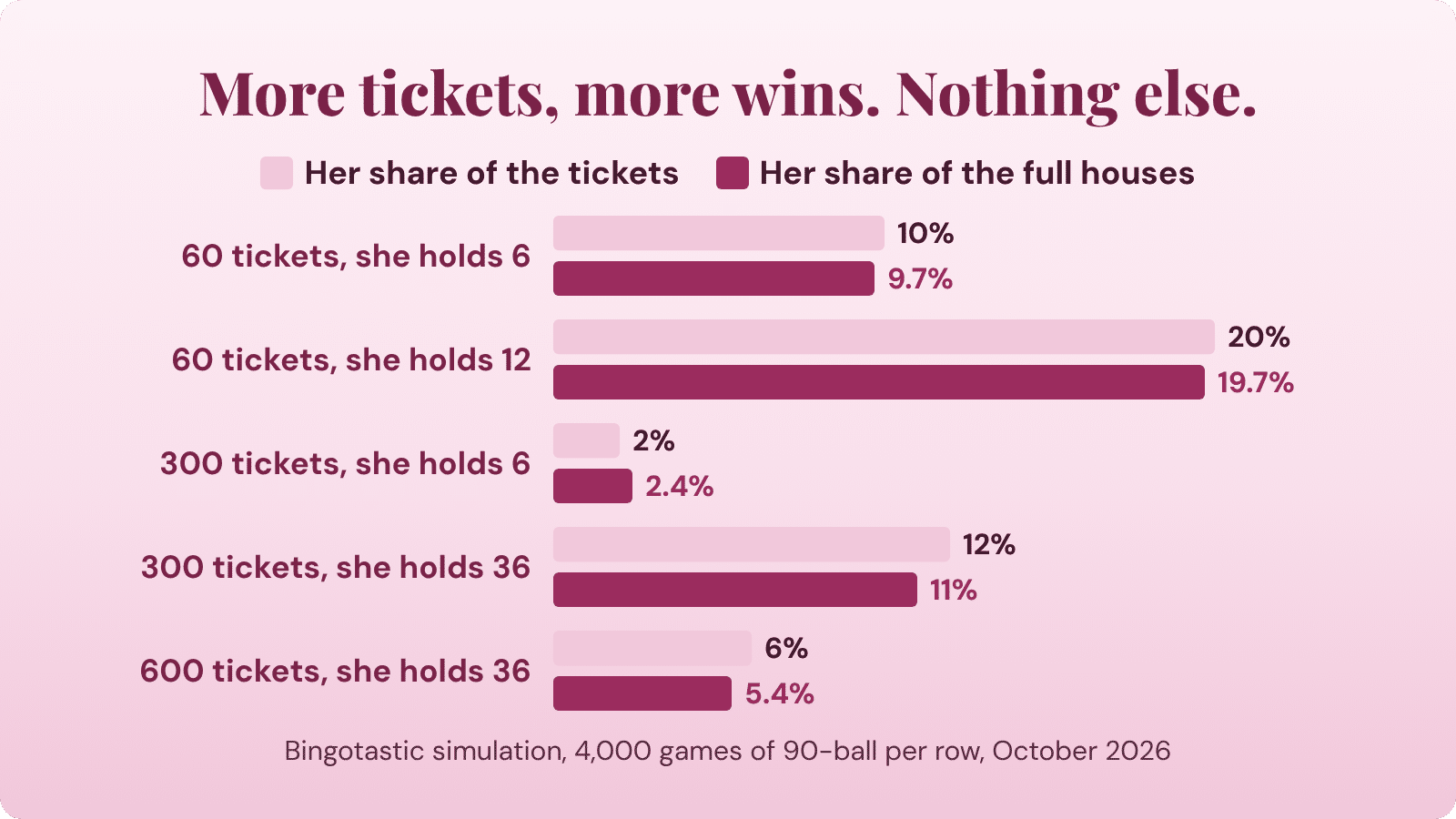
Under equal-chance rules, every ticket has the same shot, so your share of the wins should match your share of the tickets. We wanted to see how closely that holds in practice, so we ran 4,000 simulated games for every room size below and counted who took the full house. The tickets followed real strip rules (six tickets per strip, each number from 1 to 90 appearing once) and tied prizes were split.
| Tickets in the room | Tickets one player holds | Her share of the tickets | Her share of the full houses |
|---|---|---|---|
| 60 | 6 | 10% | 9.7% |
| 60 | 12 | 20% | 19.7% |
| 300 | 6 | 2% | 2.4% |
| 300 | 36 | 12% | 11.0% |
| 600 | 36 | 6% | 5.4% |
The wins track the tickets almost exactly. Now picture a quiet afternoon room with 60 tickets in play, where one regular buys two strips (12 tickets) every game. She’ll take roughly one full house in five. Over a ten-game session, the odds of her winning three or more are about one in three. To everyone else in the chat, that looks like she “always wins”. To the maths, it’s just 12 tickets out of 60.
There’s a flip side worth knowing. Buying more tickets does win you more games, but it costs more in exactly the same proportion, so you’re paying for a bigger slice of the same pie.
Payout Rates Aren’t the Same as Odds
Every bingo game keeps back part of the ticket money, and the rest goes out as prizes. The share that goes back is the payout rate. It’s set room by room, and it’s how the site earns its keep.
In our experience, not many sites publish it, which is a shame because it clears up a common mix-up. Butlers Bingo is among the handful we’ve seen that does. Its terms say its bingo payout rates “range from 65% to in excess of 100%”, with the top end coming from guaranteed games, where a promised prize is paid out in full even when ticket sales fall short, and the site makes up the gap.
A payout rate tells you how much of the pot comes back to players as a group. It doesn’t change your chance of winning, which is still set by your share of the tickets. A room with a low payout rate is simply taking a bigger cut of the ticket money, and you’re entitled to shop around for rooms that take less.
Common Worries About Online Bingo
Do new players win more, to ‘hook’ them in?
No. A game can’t adjust itself to who’s playing, because compensated games are banned. What does exist is newbie rooms, separate rooms that only new accounts can enter, often with free or cheap tickets and small prizes. You win there more easily because fewer people are in the room, not because the numbers treat you kindly. We’ve explained how newbie rooms work in more detail elsewhere.
Can a site change the odds halfway through a game?
No. You can’t change rules, payouts, or probabilities while a game is available to play, beyond what its published rules allow. Changes must be made with the game offline, and players must be told.
Are the other players real?
This is the worry we found hardest to settle from the rules alone, so we’ll stick to what we can show. Operators ban players from using bots. Spectra Bingo’s terms, for example, allow it to take action against anyone who has used “computer software or other automated systems such as ‘bots'” to interfere with its games. And under the equal-chance rule, every ticket in the room has the same chance as yours. If something in a room ever looks wrong to you, raise it with the site and use the complaints route below.
What happens if my connection drops?
On a typical licensed site, nothing bad happens. Butlers’ bingo rules, for one, say the game carries on and credits any winnings to your account automatically. Its rules also say a prize won by more than one player on the same number is shared equally between them. We’ve seen this across the industry and have never seen any site operate outside this procedure.
Is it any different in a bingo hall?
The same equal-chance principles apply to bingo wherever it’s played, and the hall version has the advantage of being out in the open. If you’d like to understand the game first, our guide on how to play bingo covers the rules, tickets, and how long a game usually lasts.
Is Online Bingo Safe and Legal in the UK?
Yes, as long as the site holds a Gambling Commission licence. Online bingo is legal for adults in Great Britain, and licensed sites must do more than run a fair draw.
- Age and identity checks come first. Site terms note that the Commission requires it to verify every customer’s age and identity before they can play, deposit or withdraw.
- Every licensed site is part of GAMSTOP. The Commission made it compulsory for all online operators to join the national self-exclusion scheme from 31 March 2020, so one sign-up blocks you from every licensed site at once.
- You can set your own limits. Licensed sites let you cap your deposits (Gala’s settings, for example, offer daily, weekly, or monthly caps), and it’s worth setting limits before you start rather than after.
- Disputes go to an independent body. More on that below.
The real risk is the unlicensed site that looks friendly and offers a bonus that’s too good to be true. That’s why the licence check below matters more than any review.
How to Check a Bingo Site Is Licensed
It takes about a minute, and you don’t need to take anyone’s word for it, including ours.
- Find the licence line in the bingo site’s footer. It will name the operating company and give a Gambling Commission account number.
- Go to the Gambling Commission’s public register and search for that account number or company name.
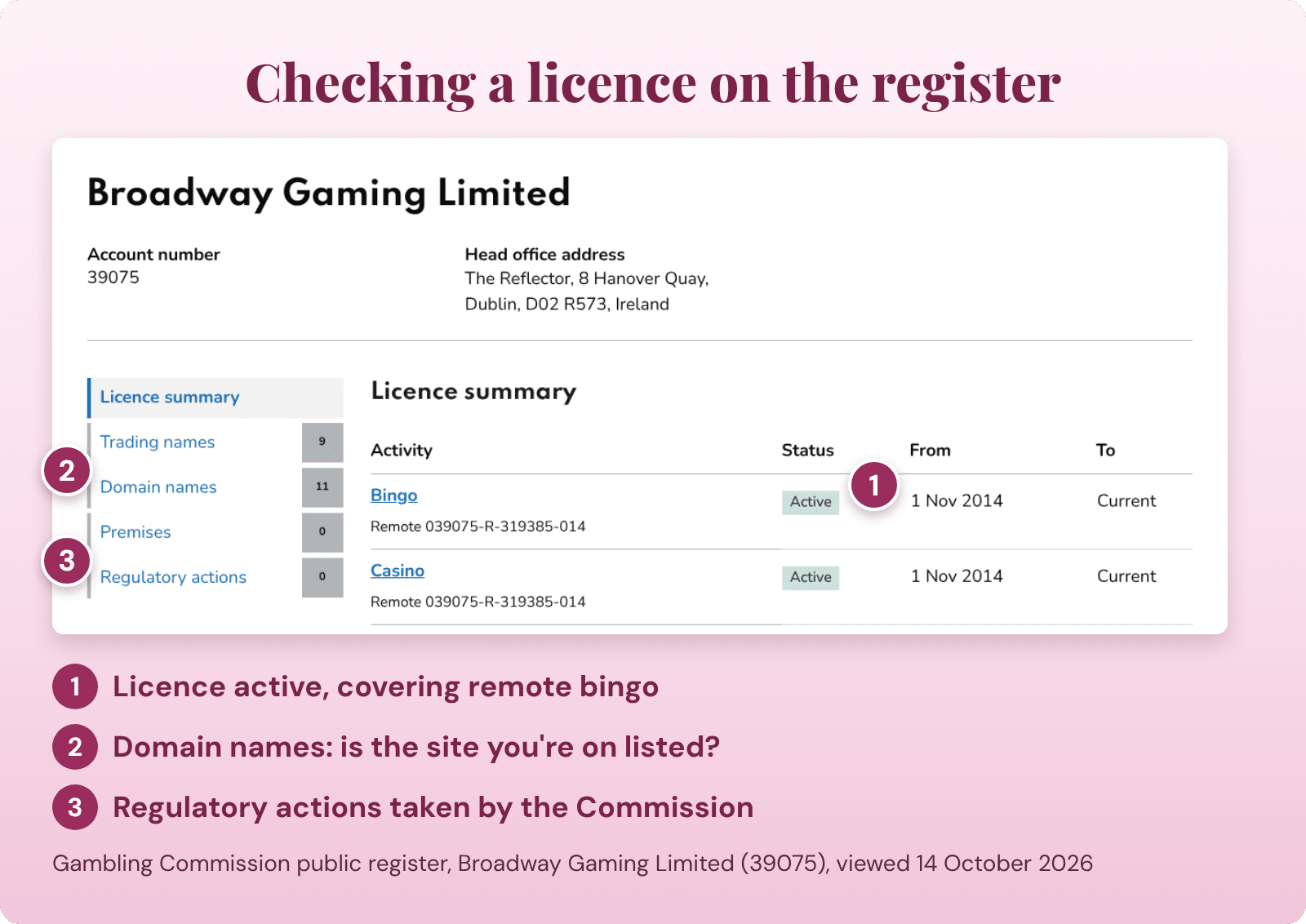
- Check that the licence summary says Active and covers Remote bingo.
- Open the Domain names tab and make sure the site you’re on is listed. This is the step people miss, and it’s the one that catches copycat sites borrowing a real licence number.
- Glance at Regulatory actions to see whether the Commission has taken action against the company.
For example, Butlers Bingo’s operator, Broadway Gaming Limited, appears on the register under account 39075 with an active remote bingo licence and a list of the domain names it covers.
We check every site against the register before it appears in our recommendations, and when a site closes or loses its licence, we keep its page up without links and say why. We list them together under closed bingo sites.
If You Think a Game Was Unfair
Start with the site itself. The Commission advises you to complain directly to the gambling business first, with dates, times, and amounts, and to keep a copy of everything you send. The business then has eight weeks to resolve it.
If it doesn’t, or you’re unhappy with the answer, you can take it to an alternative dispute resolution (ADR) provider, which the Commission describes as “a free, independent service”. Look in the site’s terms for the name of its ADR provider. For example, many sites use eCOGRA. You can’t skip the first step, though. ADR will only review a complaint after the site has completed its own process.
The Bottom Line
Online bingo at a licensed UK site isn’t fixed. The numbers come from a tested random number generator, the rules ban the tricks people worry about, and every ticket has the same chance. What feels like rigging is usually just someone playing more tickets than you, in a room with fewer players than you’d think.
If you’d like a starting point, our best bingo sites guide only lists sites we’ve checked against the register.