
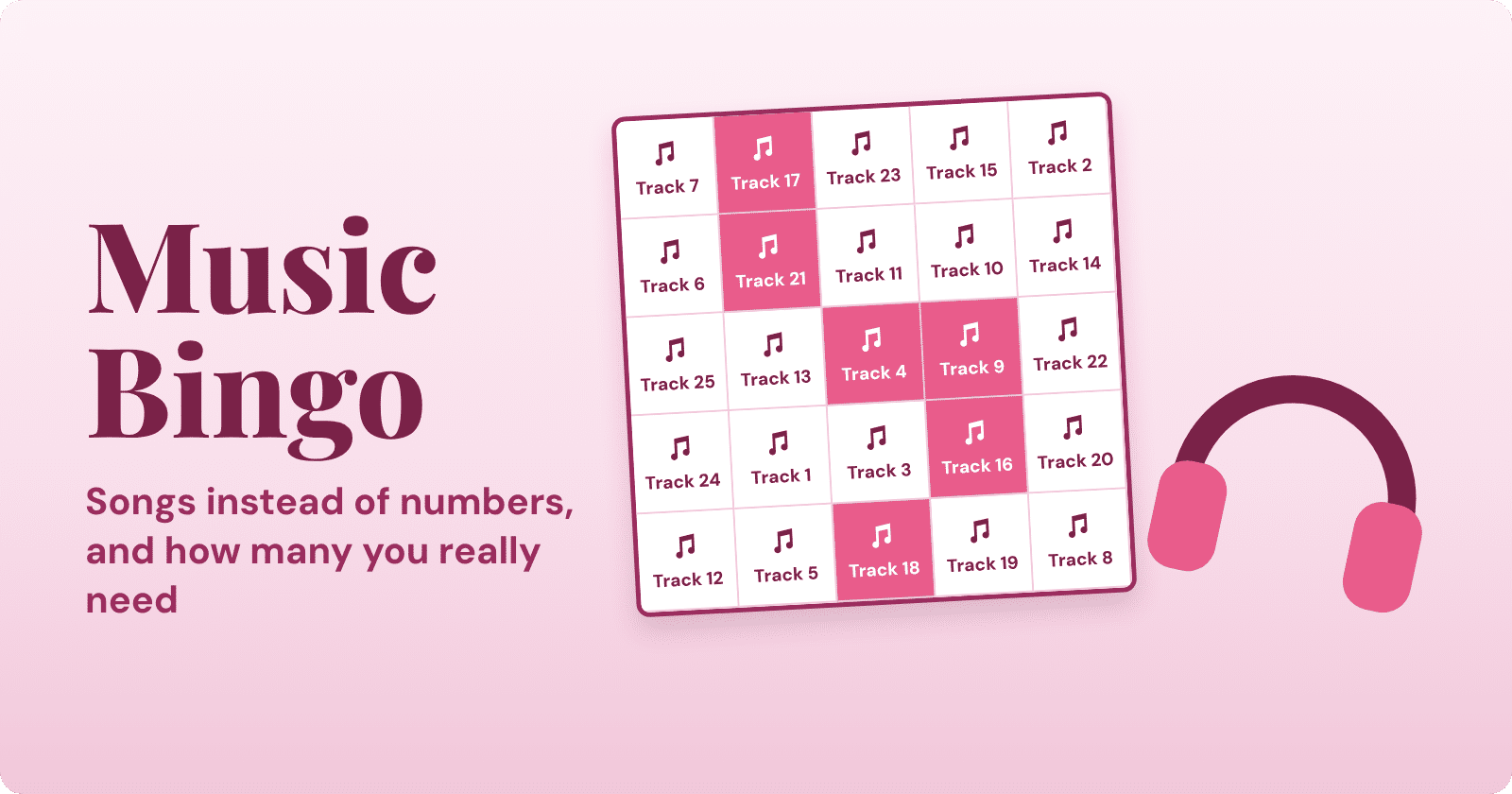
Music bingo swaps the numbers for songs. The host plays a short burst of each track, and you mark it off if the title is on your card. It’s the same game as ordinary bingo, but it plays very differently because your playlist size decides almost everything about the night.
We simulated 24,000 games to work out how many songs you need, how long a round lasts and how often two people win on the same song.
What Is Music Bingo?
Everyone gets a card printed with song titles, or sometimes artists, instead of numbers. The host shuffles a playlist and plays a clip of each track. If you recognise a song that’s on your card, you mark it. The first player to complete the pattern for that round shouts, and the host checks their card against the list of songs played so far.
With a 5 x 5 grid, you play for shapes 75-ball fans already know, like a straight line in any direction, all four corners, or a completely filled card. If pattern games are new to you, how to play bingo covers them step by step.
The twist is that recognising the song takes skill, which normal bingo doesn’t have. The order the songs come out is still pure luck, though, and so is which titles end up on your card.
How Many Songs Do You Need for Music Bingo?
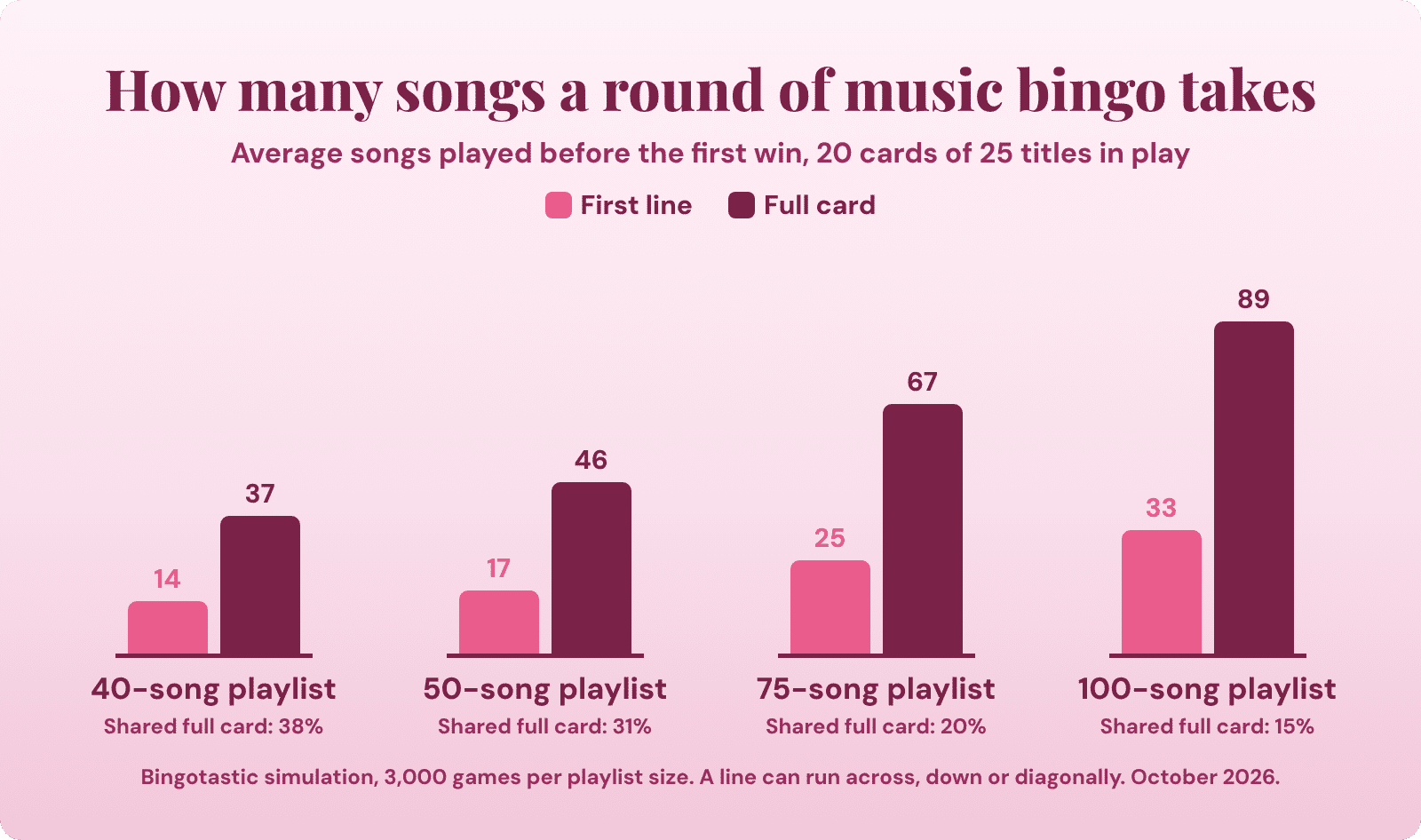
This is the question every new host asks, and nobody gives a straight answer. So we ran the numbers. We built cards of 25 titles drawn at random from playlists of 40, 50, 75, and 100 songs, played 3,000 games at each size, and recorded when the first line and the first full card appeared. This table is for a room with 20 cards in play.
| Playlist size | First line | Full card | Shared full card |
|---|---|---|---|
| 40 songs | After 14 songs | After 37 songs | 38% of games |
| 50 songs | After 17 songs | After 46 songs | 31% of games |
| 75 songs | After 25 songs | After 67 songs | 20% of games |
| 100 songs | After 33 songs | After 89 songs | 15% of games |
Two things stand out. A full card needs roughly 90% of the playlist played before anyone fills it, no matter what playlist size you choose. And the smaller the playlist, the more the cards overlap, so it gets far more likely that two or more people complete their card on the same song. With 40 songs, that happened in more than a third of our games.
The room size matters less than you’d think. With 50 cards in play instead of 20, a 75-song playlist produced a first line after 21 songs rather than 25, and the full card came only a couple of songs sooner.
We recommend 50 to 75 songs per round. That’s enough to keep shared wins down without dragging the full card out for most of an hour.
How Long Does a Round Take?
That depends on how long you play each song. Hosting guides suggest anything from 20 seconds to a full minute, and the shorter end keeps the pace up. At 30 seconds a song, the numbers above turn into these times.
| Playlist size | First line | Full card |
|---|---|---|
| 50 songs | About 9 minutes | About 23 minutes |
| 75 songs | About 13 minutes | About 34 minutes |
| 100 songs | About 17 minutes | About 45 minutes |
Cut each clip to 20 seconds and everything takes a third less time. A 50-song round then finishes its full card in about 15 minutes, which leaves room for three or four rounds in a two-hour night once you add breaks and prize checks.
Making Your Music Bingo Cards
Start with the playlist, then build the cards from it, never the other way round. Each card needs a different random selection of titles from that list, or you’ll end up with a room full of identical cards and everyone winning at once.
A few things make the night run smoothly:
- Pick one theme per round. Decades, film soundtracks, one-hit wonders, or Christmas songs all work, and they let you target a different part of the crowd each round.
- Avoid duplicate titles. Two different songs with the same title will cause arguments the moment one plays.
- Decide between titles and artists. Titles are easier for most people. Artists suit a crowd of music nerds, but only if no artist appears twice on the playlist.
- Number your cards and keep a running list of every song played, in order. Checking a claim takes seconds when you can read the list back.
- Mix well-known tracks with trickier ones, so the round isn’t won by whoever was born in the right decade.
Do You Need a Music Licence for Music Bingo?
At home, no. Outside, it’s usually yes, and this is the part most hosting guides skip.
PPL PRS, the company that issues TheMusicLicence, says music played outside your home counts as a public performance, and that a business or organisation playing music will usually need the licence. If you’re putting on a one-off event and don’t already hold a licence, PPL PRS can arrange a temporary permit, and charity and community organisations may be able to apply for a discount on royalties.
If your venue already plays music to the public, ask whether its licence covers your event before you book anything separately.
Streaming services are a separate question. Spotify’s terms give you permission for “personal, non-commercial use” of its service and content. A personal account is fine for a game in your living room, but don’t assume it covers playing a playlist to a paying crowd in a pub or hall.
Prizes and the Rules
Music bingo is still a game where luck decides who wins, so if people pay to take part and there are prizes on offer, we’d run it inside the same limits as any other bingo night. Our guide to hosting a bingo night sets out rules for home games, pubs, clubs, and charity events, including what you can charge and how to set prizes.
For a home game with no entry fee, you don’t need to worry. A tin of chocolates for the line and a bottle for the full card is enough.
Running the Night
Agree on how you’ll handle a shared win before the first song plays, because with a smaller playlist, it’s likely. Splitting the prize is the fairest option. A quick tie-breaker also works, like playing one more song and giving the prize to whoever names the artist first.
Keep the patterns simple. One line, then a full card, is plenty for a single round, and it guarantees at least two winners every time. If you want more prizes, add a four corners game as well.
Finally, test your sound before anyone arrives. A clip that’s too quiet at the back of the room is the quickest way to lose a crowd, and with music bingo, people can’t play what they can’t hear.
If you’d rather run a traditional numbers game another night, our bingo card generator will print tickets for a classic numbers game at no cost.