
Before you print a single ticket, work out which set of rules your bingo night falls under. In Great Britain, the Gambling Commission has separate rules for bingo at home, in a pub, in a members’ club, and for charity, and each sets out what you can charge and what you can give away.
Get that right, and the rest is easy. Below we’ve put every set of rules side by side, explained the trap that catches online fundraisers, and simulated 10,000 games to show how many you can fit into an evening.
Do You Need a Licence to Run a Bingo Night?
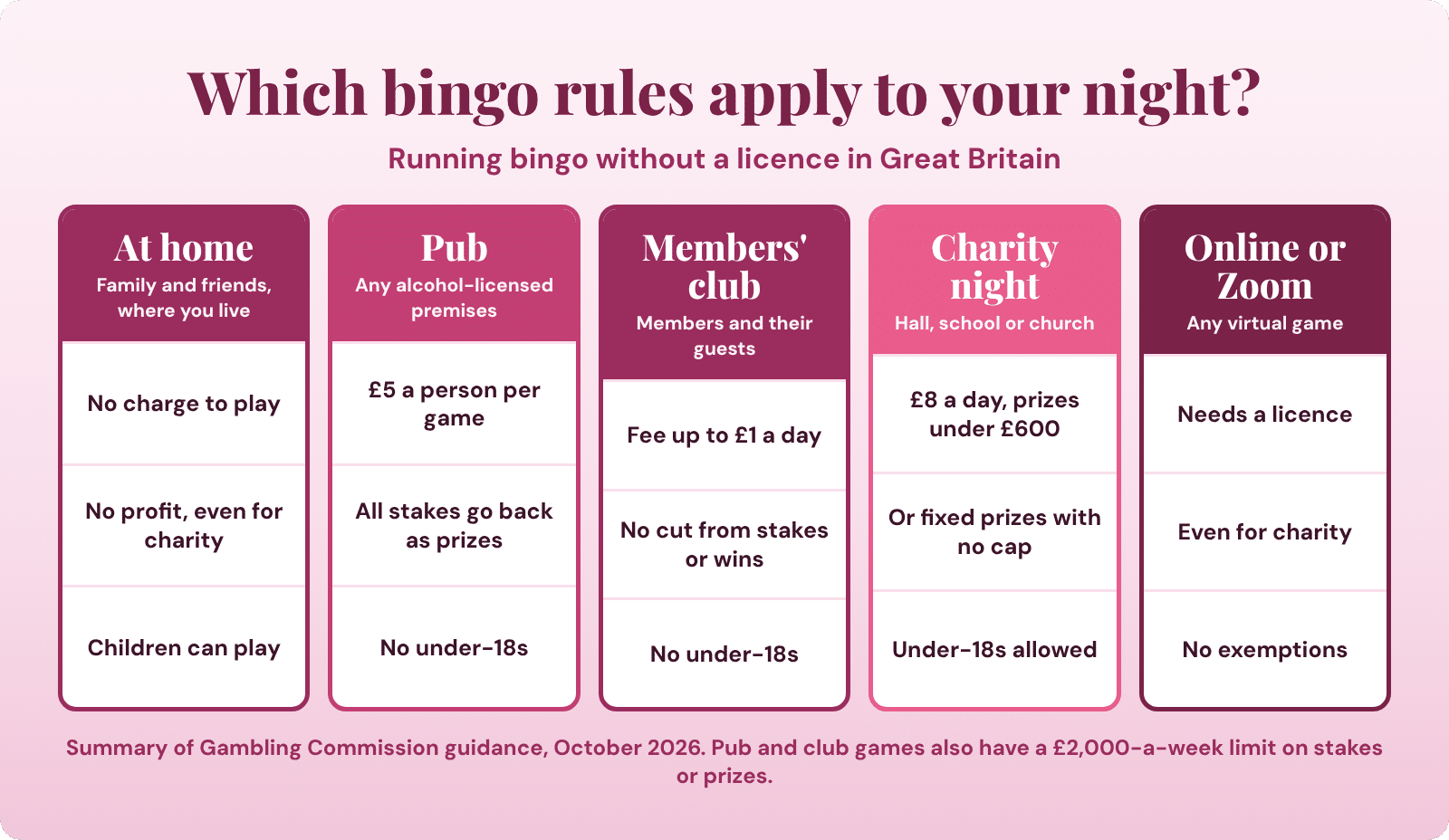
Usually not. The Gambling Commission lets you run bingo without a licence in most everyday settings, as long as you stick to the limits for that setting. These are the main ones.
| Where you play | Charge to play? | Raise money? | Under-18s? |
|---|---|---|---|
| At home | No | No | Yes |
| Pub | £5 a game | No | No |
| Members’ club | £1 a day | No | No |
| Charity night | Up to £8 or unlimited | Yes for the cause | Yes |
| Online or Zoom | Licence needed | Licence needed | Licence needed |
Halls of residence and hostels have their own version of the home rules, which we cover below. The pub, club, and charity rules also require an equal-chance game, where every ticket has an equal chance of winning, and nobody plays against a bank. That’s how normal bingo works anyway.
These rules come from the Gambling Act 2005, which covers England, Scotland and Wales. If you’re organising a night in Northern Ireland, check the rules there separately, because they aren’t the same law.
Bingo Nights for Charity
Fundraising bingo is the only setting where you can raise money, and the Commission offers two routes. Pick one before you set a ticket price, because they work very differently.
Equal chance gaming. You can charge each player up to £8 per day, and that £8 must cover everything, including entry, tickets, and any other payment linked to the games. The prizes across the whole event must total less than £600. The one exception is the final of a series, where every player has taken part before, which can offer up to £900.
Prize gaming. You can charge anything and give away anything. The condition is that prizes must be fixed in advance, and their value can’t depend on how many people turn up or how much money comes in. The Commission’s own advice is to advertise the prizes before the night.
That second rule rules out a popular idea. Paying the winner half the takings means the prize depends on how much you raise, which prize gaming doesn’t allow. You’ll also find fundraising guides that quote the £8 and £600 limits for prize gaming. Those numbers apply to route one, and mixing them up can leave you charging less than you’re allowed or offering prizes you aren’t allowed.
Whichever route you choose, a few rules apply to both:
- Tell players which good cause the money is going to before they play.
- You can deduct reasonable costs, such as prizes, tickets, and refreshments, and donate the rest to the cause.
- Nobody can make a private profit from the night, either personally or through a business.
- Under-18s are allowed to play.
If you’d like a raffle as well, the Commission treats a raffle held at an event as an incidental lottery. It doesn’t need a licence, but it must follow the rules set out in the Commission’s guide to lotteries at events.
Bingo at Home, in the Pub or at a Club
At home. The Commission calls domestic gaming a game with family or friends at a dinner party or small get-together. It must take place in the home you usually live in, and you can’t charge anyone to join or keep any profit, even for charity. Children can play.
In halls of residence or a hostel. Shared accommodation comes under residential gaming. The rules are much the same as at home, with no fees or profit, plus one extra condition: at least half the players must live there.
In a pub. Any premises with an alcohol licence can run bingo. The stake is capped at £5 per person per game; total stakes or prizes can’t exceed £2,000 in a seven-day period; and every penny staked must go back out as prizes. The pub can’t charge a fee to play or take a cut, and under-18s can’t join in. If another event that night has an entry charge, bingo players still have to be let in for free.
In a members’ club. Club bingo follows similar rules, except that the club can charge a participation fee of up to £1 per person per day, or £3 in a commercial club with a club machine permit. Players have to be members or guests of a member, the club can’t take a cut of stakes or winnings, under-18s can’t play, and the same £2,000-a-week ceiling applies.
The common thread is that only a charity night can raise money, and then only for the good cause. At home or in the pub, every pound staked comes back out as prizes.
Why You Can’t Run Bingo on Zoom
This is the rule most likely to catch people out. The Commission says you need a licence for any bingo where players take part virtually, including games played over social media or on a video call using platforms such as Zoom.
Good intentions don’t change it. Even a charity game can lead to a fine or prosecution.
None of the exemptions above work remotely, either. The fundraising rules apply to people in the same room, so if you can’t all meet in one place, the Commission advises choosing a different fundraising activity.
How Many Games Fit in a Night?
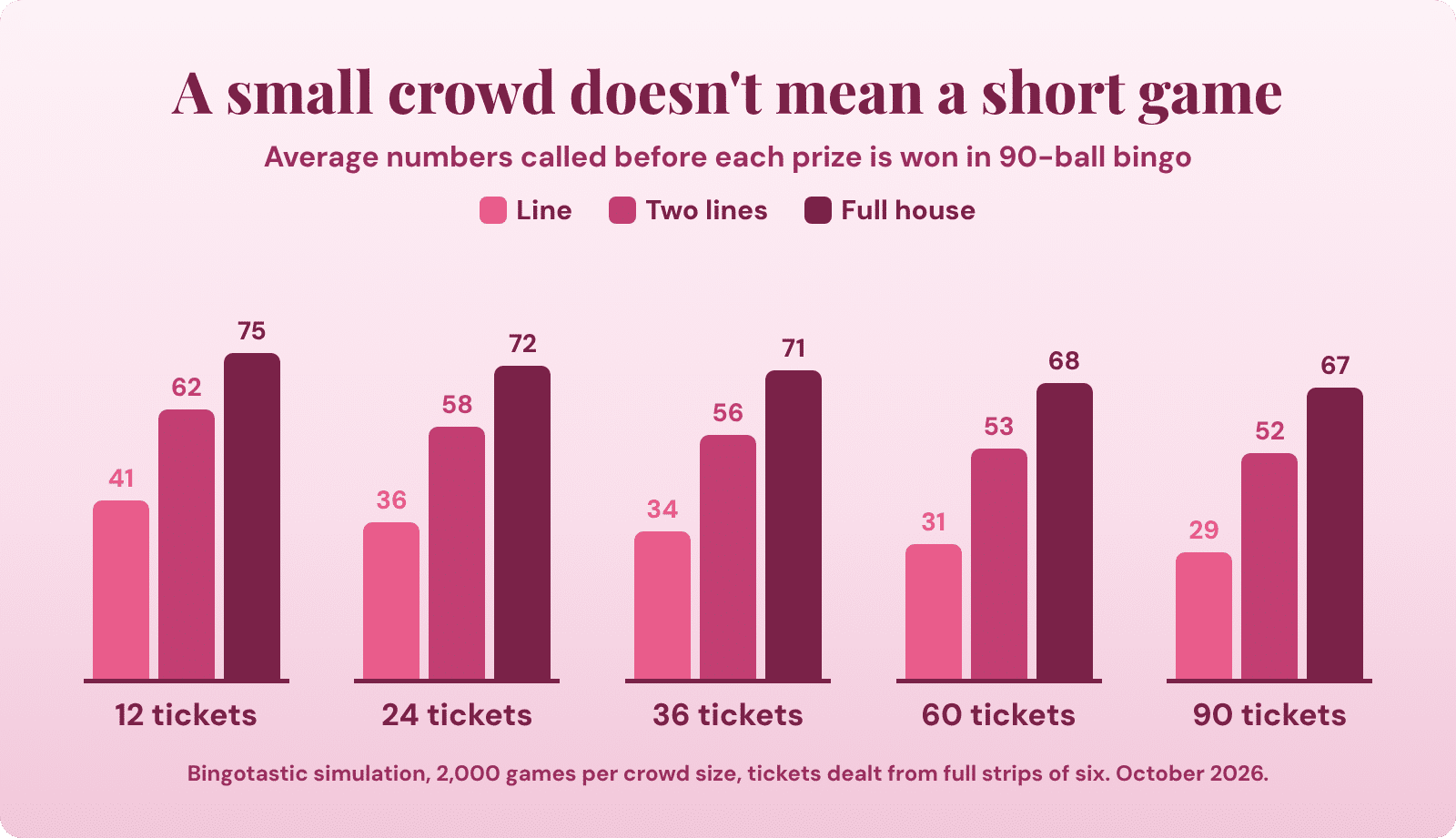
Most organisers assume a small crowd means quick games. It doesn’t. Our how to play bingo guide already timed games in busy rooms, so for this guide we simulated the smaller crowds a home or charity night gets, running 2,000 games of 90-ball for every crowd size, with every ticket dealt from a proper strip of six.
| Tickets sold | Line | Two lines | Full house |
|---|---|---|---|
| 12 | 41 calls | 62 calls | 75 calls |
| 24 | 36 calls | 58 calls | 72 calls |
| 36 | 34 calls | 56 calls | 71 calls |
| 60 | 31 calls | 53 calls | 68 calls |
| 90 | 29 calls | 52 calls | 67 calls |
The line comes noticeably later in a small room, but the full house barely moves. Going from 12 tickets to 90 saves only about eight calls, because someone still has to cover all 15 numbers on one ticket, and that takes most of the 90 balls, no matter how many people are playing.
Plan the evening by the clock, not the guest list. A practised caller gets through a game in about ten minutes, which is roughly how long Buzz Bingo’s hall games take.
A volunteer reading numbers for the first time will be slower, and checking each claim adds a minute or two. Allow 15 minutes a game, and you’ll fit six to eight games into a two-hour night with a break in the middle.
What You’ll Need
- Tickets. Our bingo card generator costs nothing and prints as many 90-ball, 75-ball, or 30-ball cards as you like, with numbered cards that make checking a claim much quicker, a large-print option for older players, and a caller’s checklist to tick off as you go.
- A way to draw numbers. A cage and balls look the part, but drawing numbered slips from a bag works just as well. What matters is that every number has the same chance of coming out.
- Something to mark with. Dabbers are the traditional choice and cost a couple of pounds, though a pen works too.
- A checker. Have someone other than the caller read back a winning ticket to keep everything above board.
- A microphone if the room is bigger than a living room. Numbers called into a noisy hall get misheard, and misheard numbers cause arguments.
If you’re not sure whether to play 90-ball or one of the faster games, our guide to bingo types lays them side by side. A 30-ball round is over in a fraction of the time, which helps if the crowd gets restless.
Prizes and Pricing
For a charity night run under route one, the £8 limit does the maths for you. With 40 players paying the full £8, the bingo itself can bring in at most £320, and the prizes come out of that before anything reaches the cause. That’s why many organisers rely on donated prizes, which cost nothing and leave more of the takings for the cause.
Under route two, you can charge more, but you have to decide and advertise the prizes up front. A meal voucher from a local restaurant, a hamper, or a day out all work well because their value is fixed and nobody can argue it changes with the size of the crowd.
For a game at home, there’s nothing to price, since nobody pays to play. Small prizes bought by the host, or a pot of chocolate coins, keep it fun without breaking the rules.
Whichever kind of night it is, a good mix is a small prize for one line, a slightly better one for two lines and the best prize for the full house. That gives you three winners a game and keeps more people interested until the end.
Calling the Night
The caller sets the mood for the whole evening. Read each number clearly, pause, repeat it, and use the traditional calls if the crowd enjoys them. Our list of bingo calls includes all 90, plus a printable caller’s sheet.
When someone shouts, stop calling straight away. Have the checker read the numbers back against the caller’s checklist before handing over the prize. If a claim turns out to be wrong, carry on from where you stopped, and nobody loses anything.
If you’d rather leave the calling to the professionals, our bingo halls directory has a hall somewhere near you.